Verdant 06 — Gothic: Chapel, Graveyard & Ruin [16x16]
A downloadable asset pack
356 tiles. 6 complete 47-mask autotile sets, 32 grounded props, 3 animated sets — and stained glass, which is the reason this pack looks like nothing else in the series.
Turned grave earth, withered turf, granite monuments, masonry that has lost blocks to a century of weather, and jewel-coloured light in the windows. Built on the same 16px grid and the same shared palette as the rest of the Verdant series.
The thing this pack has that the rest of the series does not
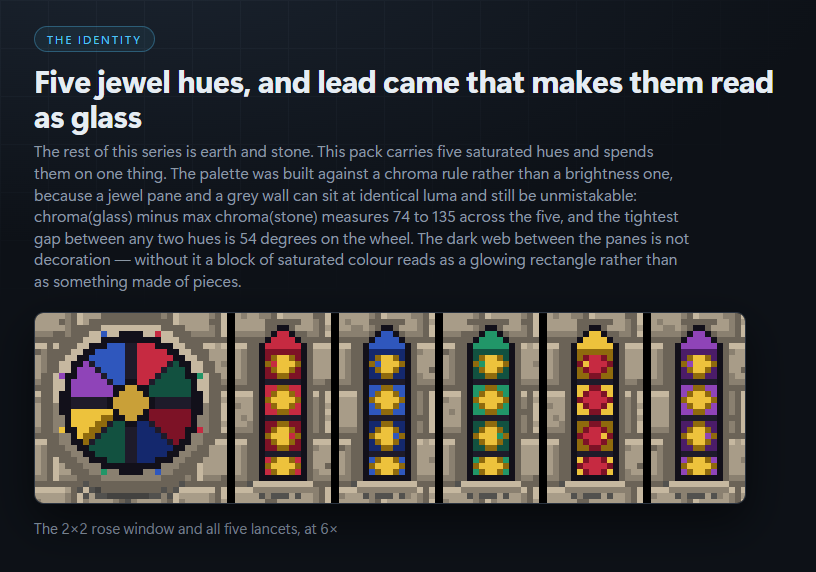
Colour that is not stone. Every previous Verdant pack is earth tones and greens. This one carries five saturated jewel hues — ruby, sapphire, emerald, amber, amethyst — and spends them on exactly one thing: stained glass. Five lancet windows, a 2×2 rose window with all five hues in it, an animated quarry window with the daylight sweeping across the panes, and three jewelled bosses on the reliquary.
That is a design constraint rather than a palette accident. Glass does not read by brightness — a jewel pane and a grey wall can sit at the same luma and still be unmistakable — so the palette was built against a chroma rule instead of a value one: chroma(glass) minus the maximum chroma of any stone in the pack measures 74 to 135 across the five hues, and the tightest gap between any two of them is 54 degrees on the colour wheel.
The result is that a window is the first thing your eye finds in a map, at any zoom, which is what a chapel window does in real life.
What is in it
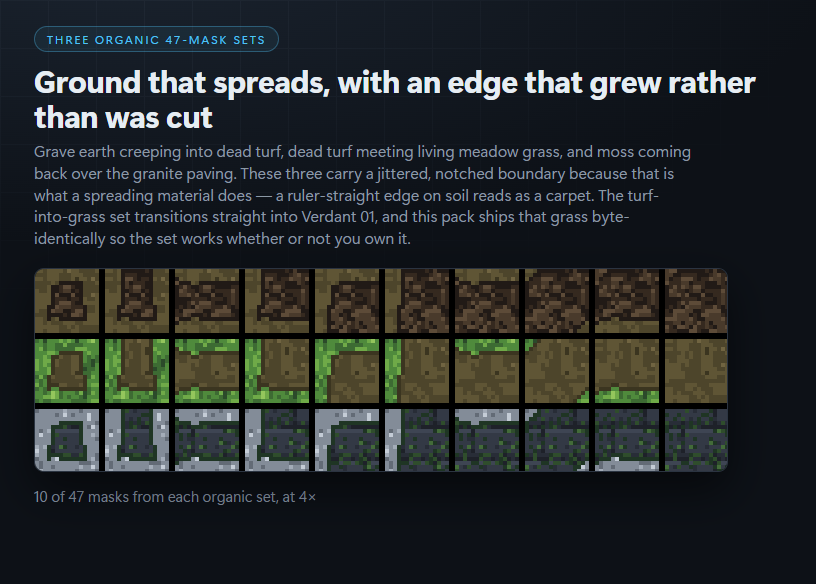
| Grave earth → withered turf, 47-mask autotile | 47 | Turned, clodded soil spreading into dead grass. Organic edge. |
| Withered turf → meadow grass, 47-mask autotile | 47 | Dead ground meeting living. Transitions straight into Verdant 01. |
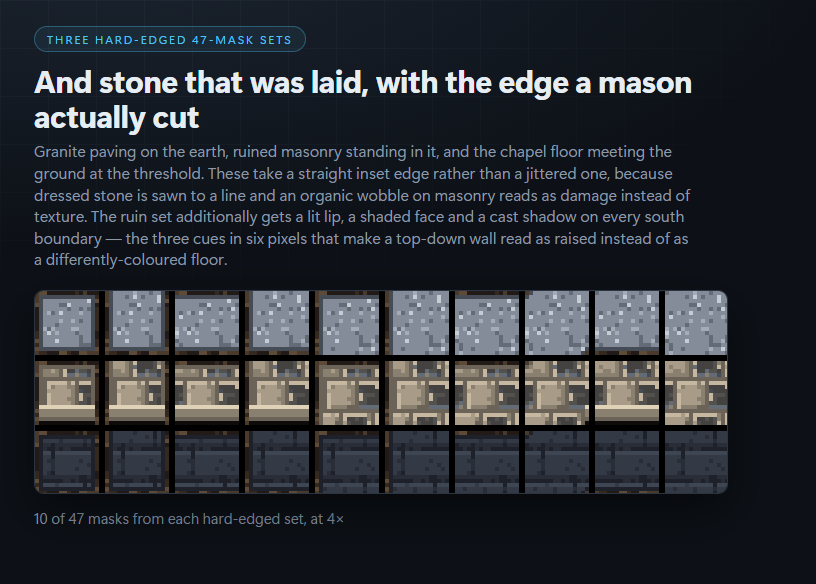
| Granite → grave earth, 47-mask autotile | 47 | Laid paving. Hard edge, because a path has an edge a mason cut. |
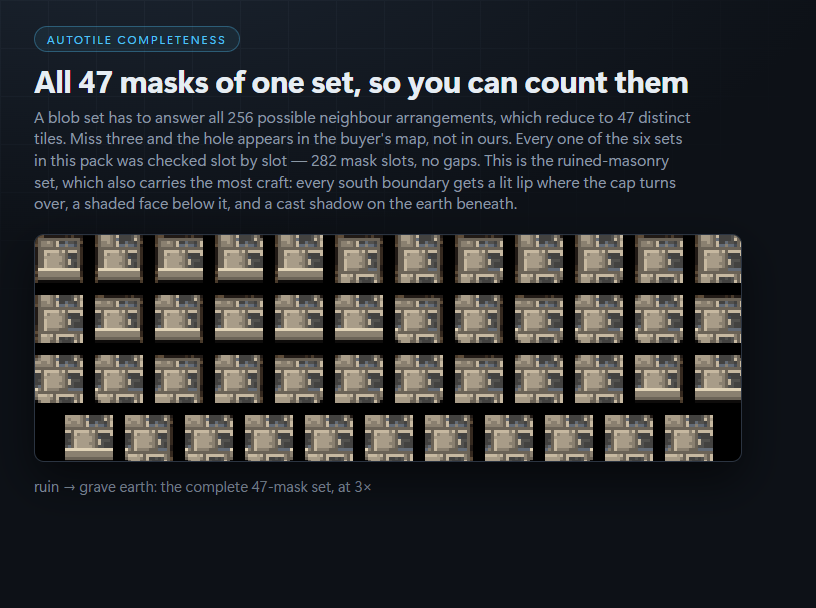
| Ruined masonry → grave earth, 47-mask autotile | 47 | Standing walls with a lit lip, a shaded face and a cast shadow. |
| Chapel floor → grave earth, 47-mask autotile | 47 | The threshold: flagstone meeting the ground outside. |
| Moss → granite, 47-mask autotile | 47 | Growth creeping back over the paving. |
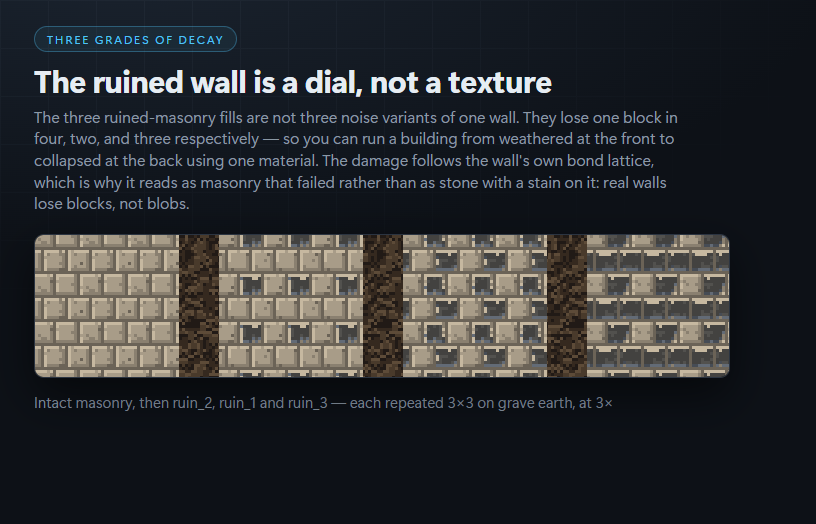
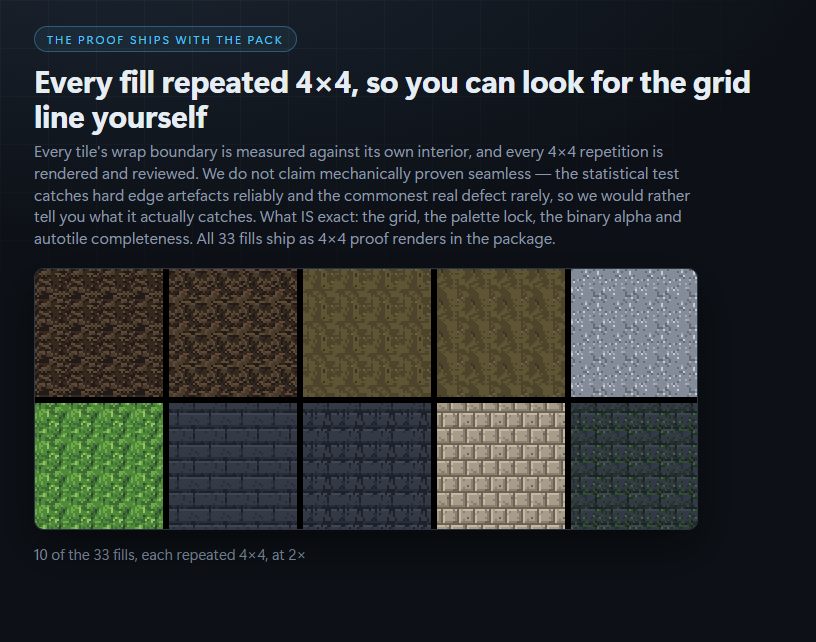
| Fills | 33 | 4 grave earth, 4 withered turf, 3 granite, 3 graded ruined masonry, 3 meadow grass, 4 flagstone, 3 worn flagstone, 3 masonry, 3 crypt brick, 3 moss. |
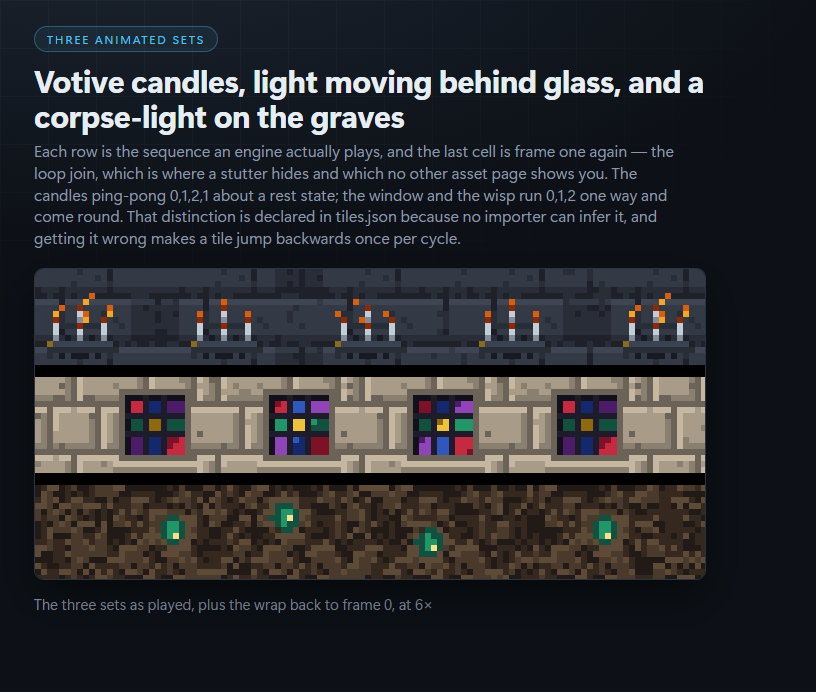
| Animated tiles | 9 | 3 sequences of 3 key frames: votive candles, a stained-glass quarry window, and a will-o'-the-wisp. |
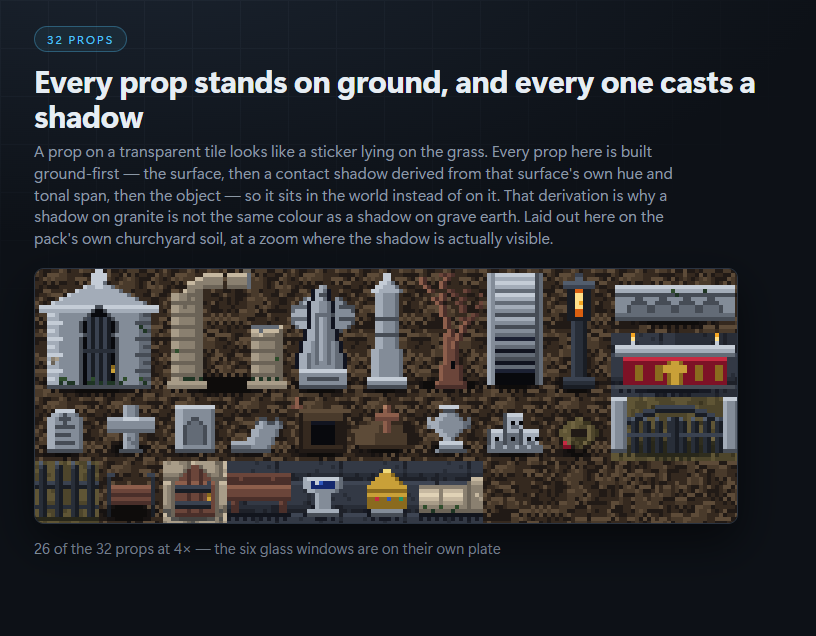
| Props, every one grounded with a contact shadow | 32 | Listed below. |
The glass: ruby, sapphire, emerald, amber and amethyst lancet windows, and a 2×2 rose window.
The graveyard: headstone, cross marker, broken headstone, tablet stone, open grave, fresh mound, obelisk, mourning angel, chest tomb, a 2×2 mausoleum, funerary urn, ossuary, dead tree, wreath, crypt steps.
The ironwork: railing, gate, lamp post, bench.
The ruin: a 2×2 ruined arch, fallen column.
The chapel: door, altar, pew, font, reliquary.
A yard needs a way in, a way down and a boundary. The gate, the crypt steps, the chapel door and the railing are in that list because a pack that cannot enclose and enter a place builds a picture rather than a level.
And the three ruined-masonry fills are three grades of decay, not three noise variants. They lose one block in four, two, and three respectively, so you can run a building from weathered at the front to collapsed at the back using one material. The damage follows the wall's own bond lattice, which is why it reads as masonry that failed rather than as stone with a stain on it.
Every tile ships three ways: one PNG per tile in tiles/16x16/, role-grouped atlases in sheets/16x16/, and a machine-readable map of tile → role → material → sheet slot → animation frame in tiles.json.
What we measured, and what we did not
This is the part most asset pages leave out. Every number here was produced by a command, and the proof renders ship inside the pack so you can look at what those commands looked at.
Machine-proven, exactly:
- Exact grid. Every cell exactly 16×16, every sheet an exact multiple. All 392 PNGs in the package checked.
- Palette lock. All 1,340,928 opaque pixels fall inside the declared 68-colour palette. Not measured afterwards — the generator physically refuses to write an undeclared colour.
- No anti-aliasing. Alpha is strictly binary across 2,082,816 pixels. No halo, no soft upscale, no partial transparency anywhere.
- Autotile completeness. 282 mask slots checked across all 6 sets. Every one of the 256 possible neighbour arrangements maps to a tile that exists.
- Series safety. 1,789 tiles across all six previously shipped Verdant packs rebuild byte-identically after this pack's 18 new colours. If you own the earlier packs, nothing you have changes.
Honestly bounded, and please read this rather than assuming:
- Seams. Every tile's wrap boundary is measured against its own interior, and every 4×4 repetition was rendered and reviewed by eye. Seamlessness is not something we claim to have mechanically proven. The statistical test is a floor rather than a proof, and we would rather tell you what it actually catches than overstate it.
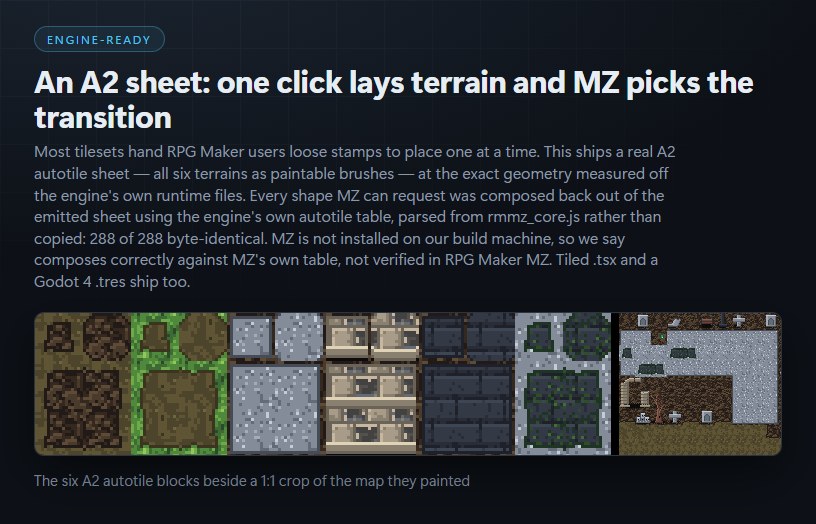
- RPG Maker MZ. The A2 sheet composes correctly against MZ's own autotile table — parsed out of the engine's
rmmz_core.js, not a copy of it — with 288 of 288 shapes byte-identical. MZ is not installed on our build machine, so that is the claim we make and we stop there. - Godot. The
.treswas loaded and verified in Godot 4.7.2 (headless): 11 atlas sources, 356 tiles, every texture resolved, every region 16×16, all 16 multi-cell footprints exact. Not exercised: the editor GUI, painting on aTileMapLayer, or a running game. - Tiled. The
.tsxfiles are written to the documented schema and parsed back for well-formedness. Tiled is not installed here, so we have not opened them in it and do not say we have.
Known and stated, because you will see it: the graveyard is built from two brown-to-olive grounds that sit close together in value — turned grave earth and dead turf. That is deliberate; a churchyard is not a colour-coded biome, and the separation you actually need is between the ground and the monuments standing on it. That one is measured: granite on grave earth scores a separation ratio of 2.98, and on withered turf 1.32, against a required floor of 1.0.
Engine importers
RPG Maker MZ. Load verdant-06-gothic_A2.png into your tileset's A2 slot and all six terrains become paintable autotile brushes — one click lays terrain and the engine picks the transition. B/C object sheets carry the props, with a JSON map of every tile to its sheet and position. These are image assets, not a plugin: no Plugin Manager entry, no script call, nothing to order, so there is no conflict possible with VisuStella MZ Core Engine or any other plugin suite. Import them through Database → Tilesets exactly as you would the stock RTP sheets.
Tiled. One .tsx per sheet with its image beside it. Godot 4. A TileSet resource with all 11 atlas sources pre-built — drop the folder in and assign it to a TileMapLayer.
The sample map
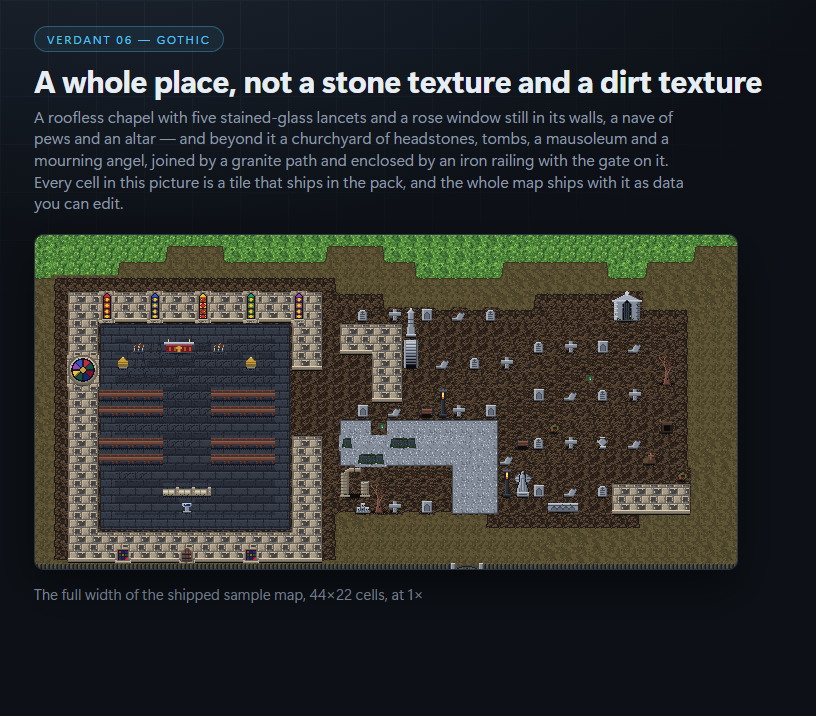
A 44×22 churchyard ships with the pack as a PNG and as JSON: every cell as a tile id, every one of its 146 props in draw order, and a legend. So you can rebuild it in any engine, edit it, or just read it to see how a finished map is assembled. It is generated by rebuilding the picture from the JSON alone and demanding a byte-identical result, so it cannot drift from what you see. It is self-contained — every tile it names ships in this pack, including the meadow grass.
The series
- Verdant 01 — Overworld terrain [16x16] — grass, dirt, sand, stone and water
- Verdant 02 — Elevation [16x16] — plateaus and cliffs
- Verdant 03 — Worlds — snow, desert and volcanic
- Verdant 04 — Tidewater — coast, river and marsh
- Verdant 05 — Depths — dungeon, cave and crypt
- Verdant Forge — Tileset Generator — the generator itself
- Verdant 00 — free sample pack — free, 64 tiles, try the style first
Same 16px cell and one shared palette across all of them. This pack ships Verdant 01's three meadow-grass fills byte-identically rather than referring to them, so the turf-into-grass set works on its own if this is your first Verdant pack and lays flush against Verdant 01's own grass if it is not. The chapel interior is Verdant 05's flagstone and masonry, unchanged, for the same reason.
Licence
Commercial use permitted, unlimited projects, no royalty, no attribution required. You may not resell or redistribute the tiles as an asset pack, and you may not use them to train a generative model.
AI disclosure
Graphics: generated programmatically. Every tile was produced by original software written by Core Systems Asset Factory, from a hand-authored palette, hand-authored motifs and hand-authored material rules. No diffusion or image-generation model was used and no third-party artwork is incorporated. Sounds: none. Text and dialog: none. We tag this pack as AI-assisted because the software that draws the tiles was itself written with AI assistance — we would rather over-disclose than have you find out later.
Purchase
In order to download this asset pack you must purchase it at or above the minimum price of $9.99 USD. You will get access to the following files:
Development log
Leave a comment
Log in with itch.io to leave a comment.