WARDLOCK
A locksmith's bench, a brass plate, and a lock that will not open until you understand it.
WARDLOCK is a real Game Boy cartridge — a 32,768-byte ROM you can put on a flash cart or an Analogue Pocket — containing forty-eight warded locks. Play the first sixteen free in your browser, right here on this page.
New in 1.4.0
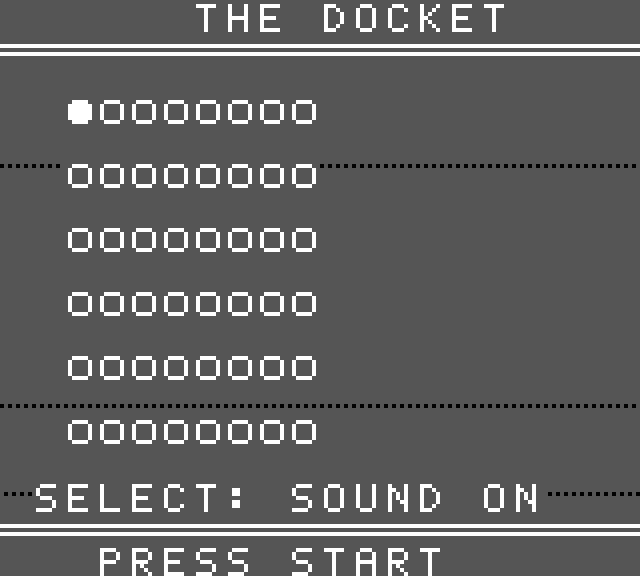
The theme now rests. The low drone under the melody used to sound on every screen without a break; now it fades and stops halfway through each phrase. SELECT on the docket (RIGHT SHIFT in the browser) turns the sound off and back on, and the docket says which. Two buttons pressed on the same frame are now both acted on instead of the second being dropped.
How a lock works
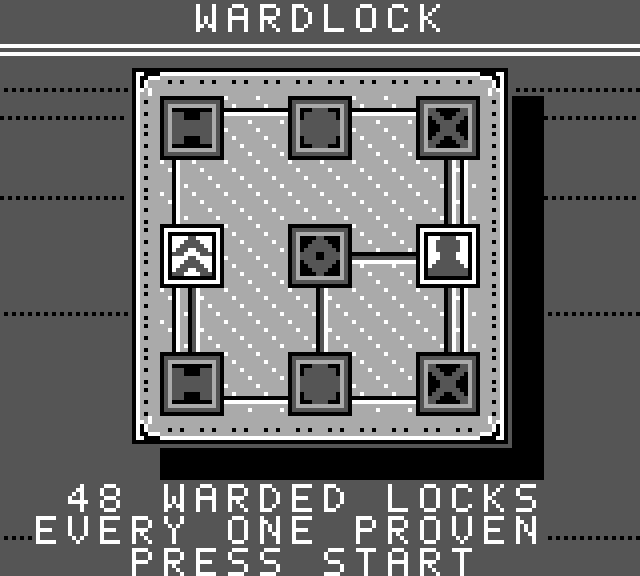
A lock is a set of wards, some shut and some already open. Open all of them and it springs.
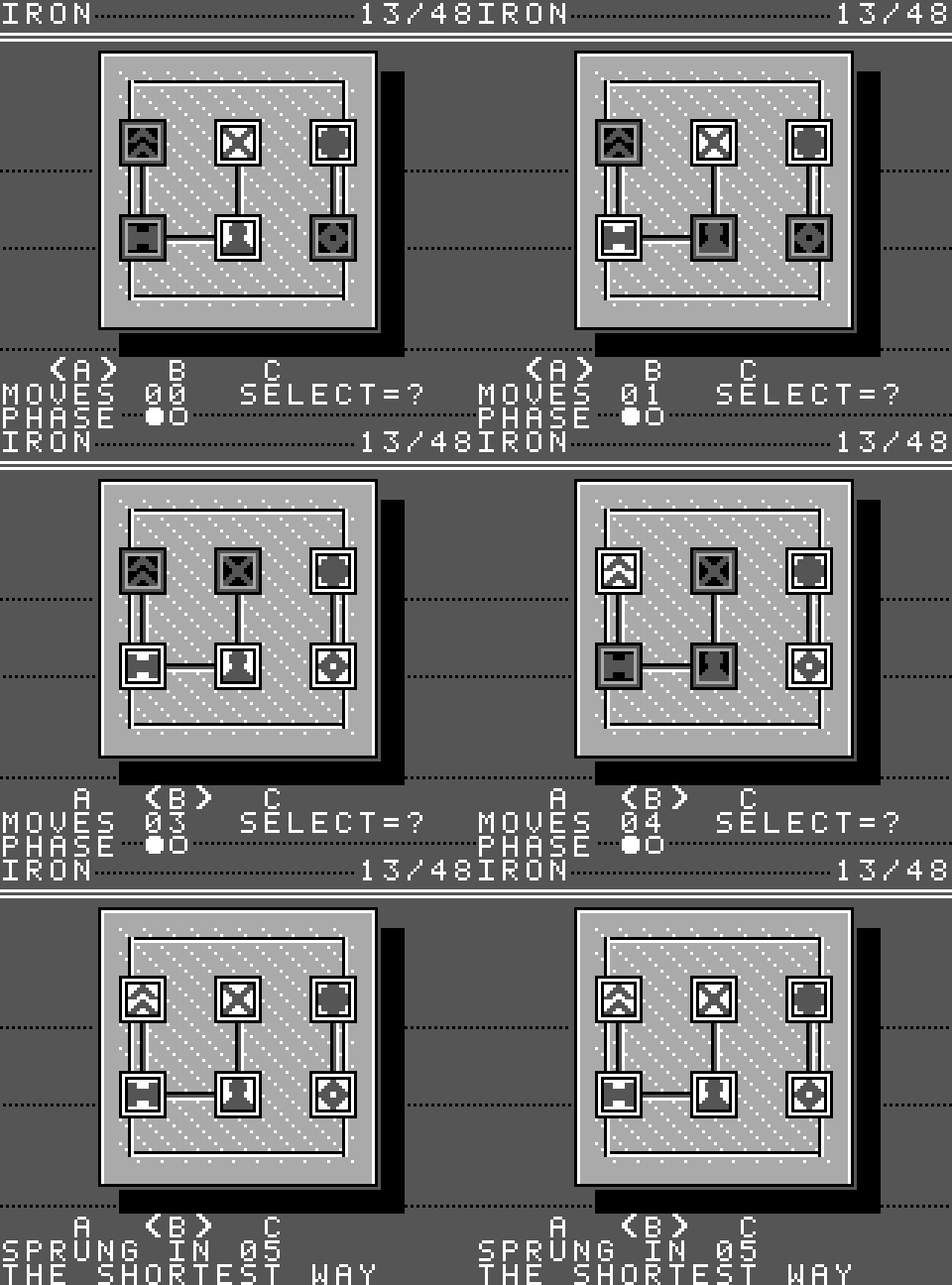
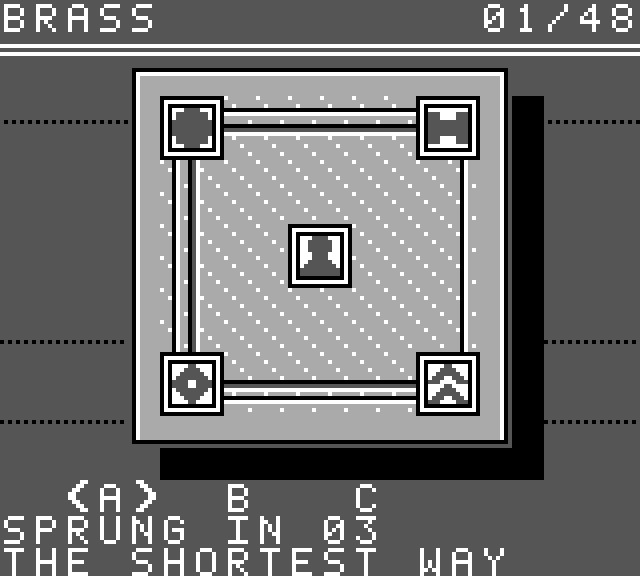
You have three or four levers. Throwing one flips a set of wards — but which set depends on the cam, a linkage with two or three phases. Some levers also turn the cam and some leave it where it is (the PHASE readout shows which), so the same lever can do different work each time round. Three levers against a three-phase cam is nine different effects to hold in your head, through two buttons.
The channels engraved into the plate show you which wards share a lever. They never tell you which lever, and they never tell you which phase. That part is yours.
Every lock ships with its proven fewest moves
Generated puzzles are usually generated and thrown away until one looks right, which produces levels with no designed idea in them. These are built the other way round.
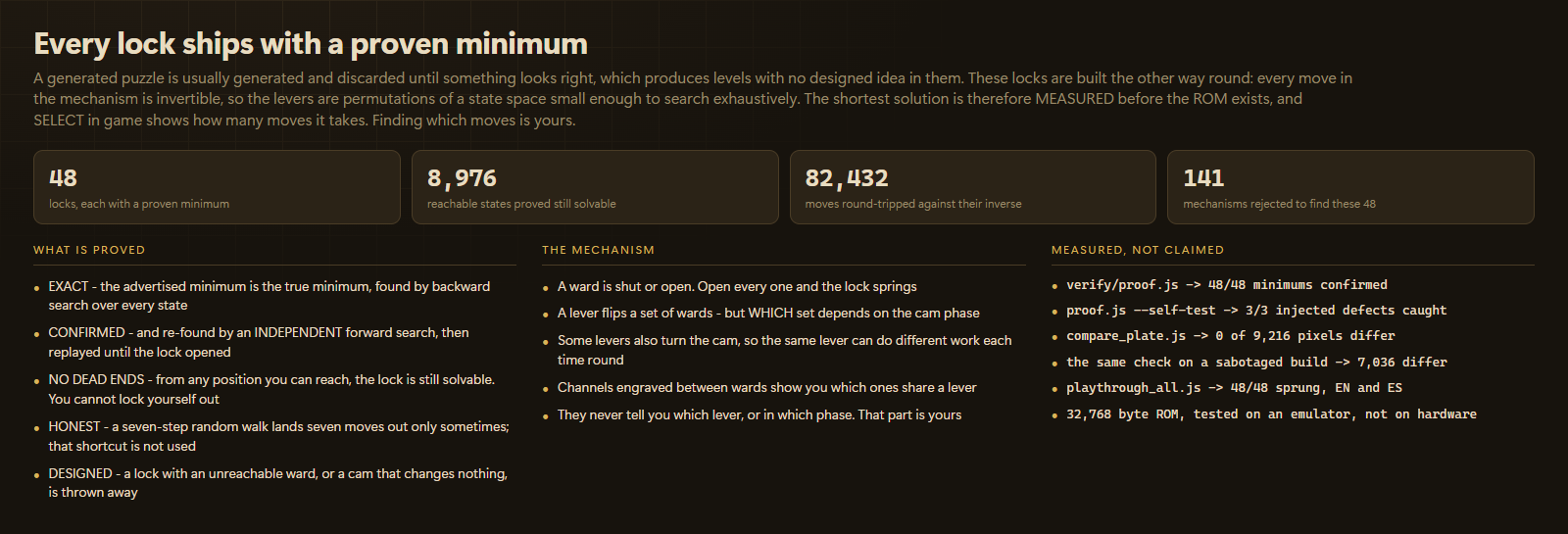
Every move in the mechanism is reversible, which makes the levers permutations of a state space small enough to search completely. So each lock's minimum was measured by exhaustive search before the ROM existed — then confirmed again by an independent search, and replayed until the lock actually opened. Press SELECT on any lock to see its number. Matching it is the game.
And you cannot lock yourself out. From any position you can reach by any sequence of presses, the lock is still solvable. That is not a promise about the level design — it is a property of the mechanism, proved across all 8,976 reachable states. Experiment freely; undo takes back up to 64 moves.
What is in it
- 48 locks across six tiers, from BRASS at three moves to THE VAULT at thirteen
- A second cartridge in Spanish,
wardlock_es.gb, beside the untouched English one - A sixteen-page printed manual, in a screen-reading edition and a fold-and-staple booklet edition, illustrated entirely with the cartridge's own output
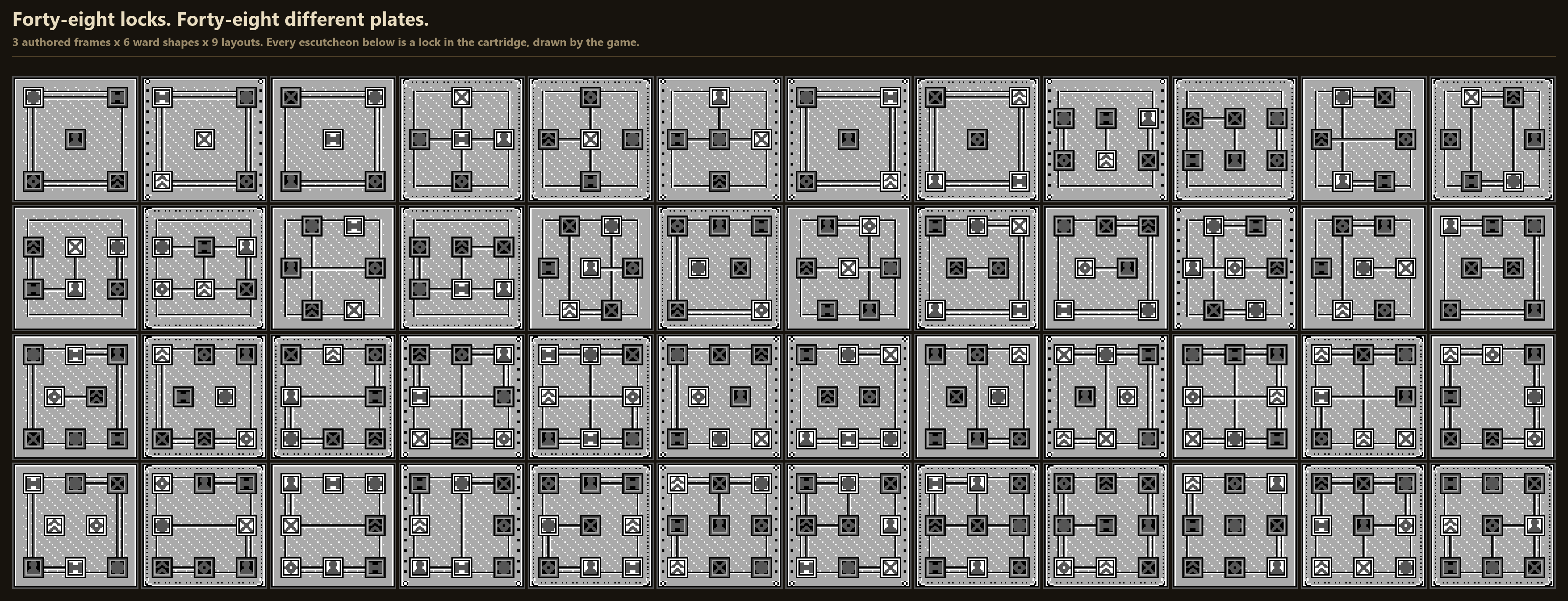
- 48 different plates. Three authored frame styles, six ward shapes and nine layouts, composed by the cartridge into forty-eight escutcheons. There is no sprite sheet in the ROM — every plate is drawn from parts, at runtime, which is how they fit in 32 KB
- The proven fewest moves for every lock, on the cartridge, one button away
- Undo up to 64 moves, because a puzzle you can wreck is a puzzle you stop experimenting with
- Game Boy sound-hardware audio: no samples, no files
The manual
Every copy comes with a sixteen-page printed instruction manual, in two PDFs:
- (single) — one A5 page per sheet, in reading order. Open it anywhere.
- (booklet) — imposed for printing. Four sheets of A4, printed double-sided flipping on the short edge, folded once and stapled twice through the fold, give you the real booklet with the cover on the outside.
It is a manual and not a readme with a border: the mechanism explained page by page, the six tiers, the full proof of why every advertised minimum is exact, the honest limits, and a two-page spread showing all forty-eight plates side by side.
Everything illustrated in it was made by the cartridge. The screens are photographs of the game actually running, driven by real button presses. The forty-eight plates come from the game's own renderer. Even the display lettering is the cartridge's own 8×8 alphabet, blown up.
Also in Spanish
The download now contains a second cartridge, wardlock_es.gb: the same forty-eight locks, the same proofs, the same plates, with the on-screen text in Spanish. It is a separate ROM — wardlock.gb is untouched and still the English cartridge byte for byte.
Two honest notes. It was translated with AI assistance and has not yet been read by a native speaker; if something reads wrong to you, please say so in the comments and it will be fixed. And this cartridge's alphabet carries no accented characters, so the Spanish is worded to avoid them rather than misspell them — "the shortest way" reads LA MEJOR RUTA, the best route, because más without its accent is a different word.
Controls
- ← → choose a lever
- X throw it · Z draw it back (undo)
- RIGHT SHIFT show the proven fewest moves for this lock; on the docket, turn the sound off or on
- ENTER continue
Said plainly
- There is no save. This is a ROM-only cartridge with no battery, so progress lasts as long as the machine is on. Locks are short; the docket is not meant to be one sitting.
- A plate takes about a second and three quarters to draw when you enter a lock. The cartridge composes all 144 tiles of the escutcheon rather than loading it, and on a 4 MHz CPU that costs what it costs.
- It has not been run on physical hardware by us. It is a standard 32 KB ROM with a valid header, verified against the two things the Game Boy boot ROM itself checks, and tested extensively on an emulator — including a pixel-exact comparison against a reference renderer and full solved playthroughs driven by real button presses. But we are not going to claim a test we did not perform.
The demo
The browser demo is the same engine with a sixteen-lock docket — tiers BRASS and IRON, which is where the cam has been taught and before the shapes widen. The other thirty-two locks are not in that file.
More Game Boy cartridges from this studio
PROOFMARK · WITNESS MARK · ANATOMIST · everything else
On an Analogue Pocket
The download is a standard Game Boy ROM with no mapper, so on an Analogue Pocket it should run through the openFPGA Game Boy core. We have not run it on Pocket hardware ourselves, and there is no .pocket build in the download.
Purchase
In order to download this game you must purchase it at or above the minimum price of $5.59 USD. You will get access to the following files:
Development log
- WARDLOCK is in the Game Boy Collection II bundle, 30% off to 21 October2 days ago
- WARDLOCK 1.4.0: the theme rests, and the docket has a sound switch5 days ago
- WARDLOCK 1.3.0: the music plays, and the cartridge has an ending6 days ago
- Browser demo update: Game Boy speed on fast screens, steady sound, a bigger pict...7 days ago
- WARDLOCK is in the Game Boy Collection, ten cartridges for $42.6034 days ago
- WARDLOCK is in the catalogue sale until 9 September40 days ago
- WARDLOCK is 30 percent off until 9 September40 days ago
- WARDLOCK is 5.59 until 9 September41 days ago
Leave a comment
Log in with itch.io to leave a comment.