WITNESS MARK
A real 32 KB Game Boy cartridge. Free browser demo right here — five cases, no download.
A witness mark is a real term from horology: the faint trace one part leaves on another, which a restorer reads to work out where things originally sat. It is physical evidence you reason backwards from, and it is what this game hands you.
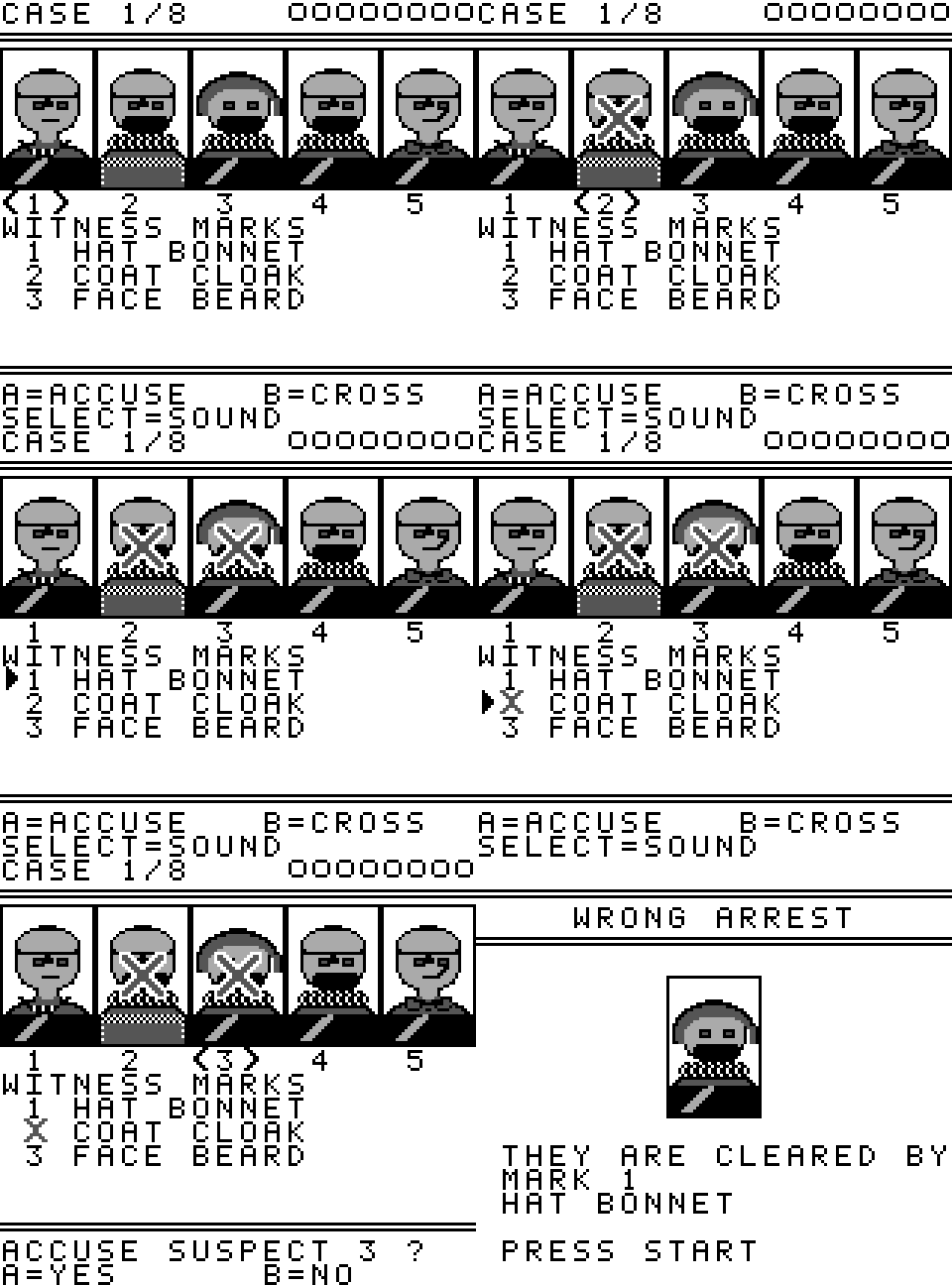
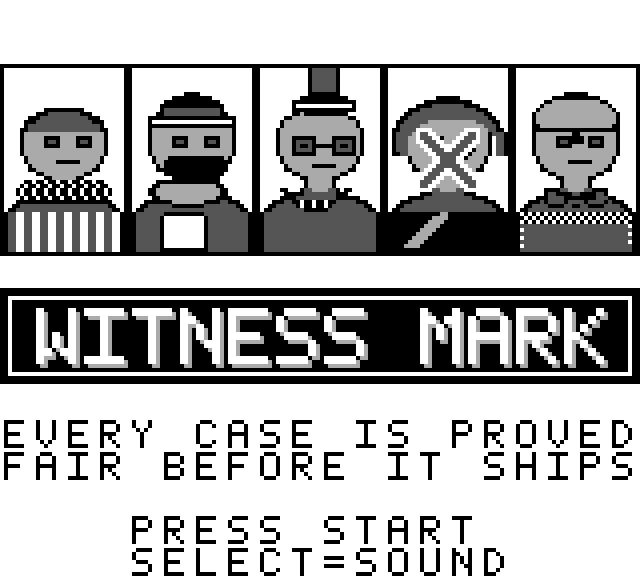
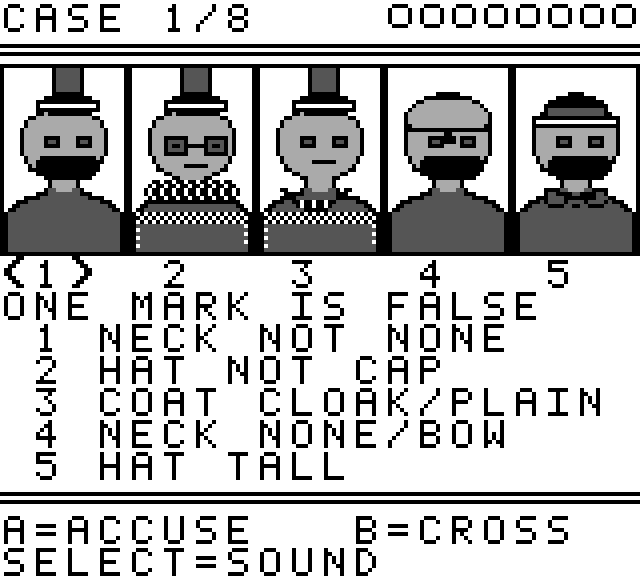
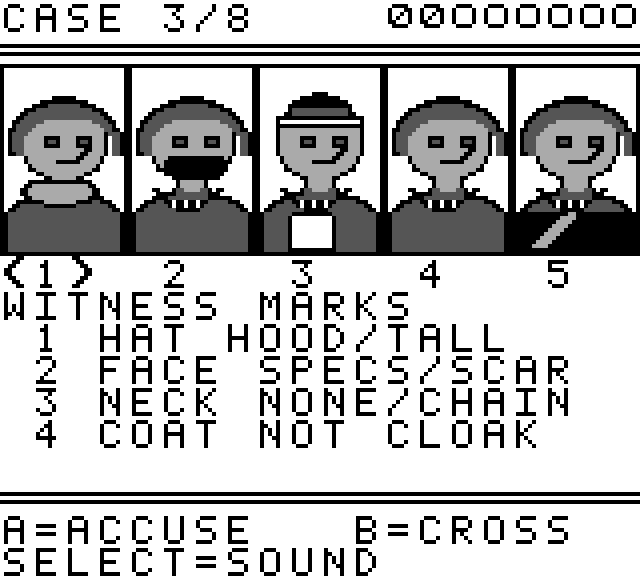
Five suspects stand in a lineup. A few marks describe the culprit — a hat, a coat, a collar, a face. Cross off who cannot have done it. Accuse who is left. You have three arrests.
The problem this cartridge is built around
Generated detective cases are common, and almost all of them are unfair: the solution is not actually entailed by what you were shown, so the honest move is to guess. That is not a hard game. It is an arbitrary one — you reason correctly, you are told you are wrong, and you conclude the game is broken.
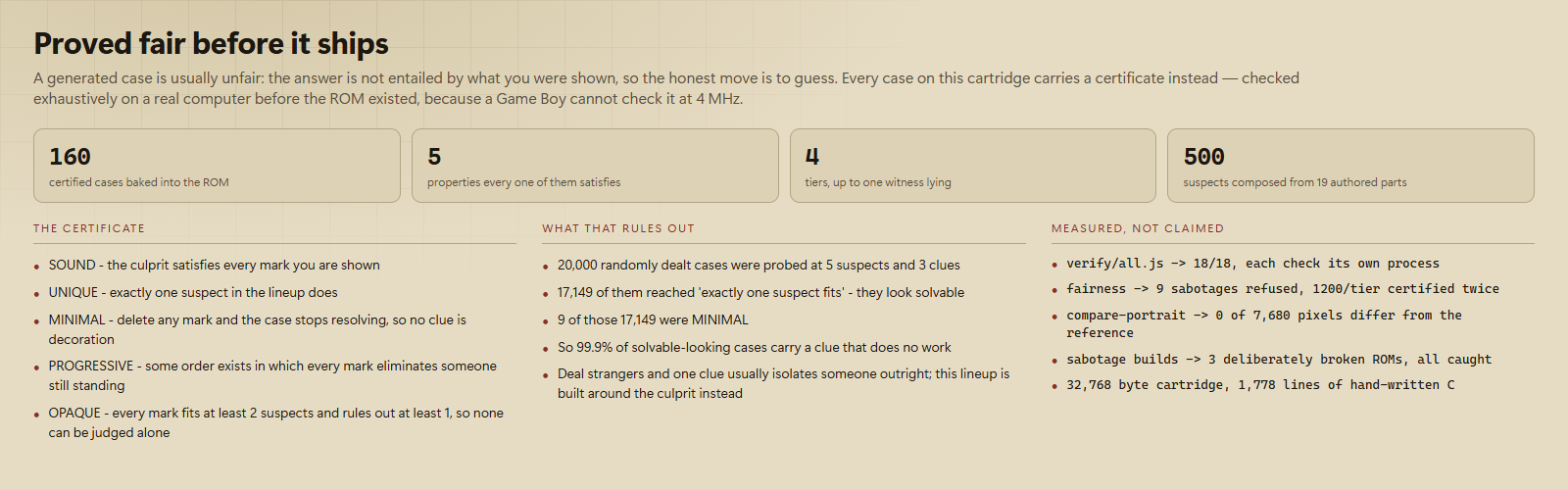
So every case here carries a proof. Not an intention — a certificate, checked exhaustively on a real computer before the ROM existed, because a 4 MHz CPU with 8 kB of RAM cannot check it. Five properties, all of which must hold:
- SOUND — the culprit satisfies every mark you are shown.
- UNIQUE — exactly one suspect in the lineup does.
- MINIMAL — delete any single mark and the case stops resolving. No clue is decoration.
- PROGRESSIVE — some order exists in which every mark eliminates someone still standing, so the case can be worked a step at a time instead of solved all at once.
- OPAQUE — every mark fits at least two suspects and rules out at least one, so no mark can be judged on its own and the answer has to come from the marks together.
Why MINIMAL is the one that matters
We measured our own dealer before building around it. 20,000 randomly dealt cases at five suspects and three clues: 17,149 reached "exactly one suspect fits" — they look perfectly solvable — and of those, 9 were minimal.
So 99.9% of solvable-looking cases contain a clue that does no work at all.
The mechanism is not subtle: deal five strangers and they differ in nearly every feature, so one clue like "wore a ring" usually isolates somebody outright and the rest is set dressing. This game therefore constructs the lineup around the culprit — everyone differs from them in only two or three features — instead of dealing it at random.
That figure is measured on our generator, not on anyone else's. We have inspected no one else's. The defensible claim is the mechanism, and it is above.
Four tiers, and the last two lie to you
Tiers one and two are plain testimony: every mark is true. From tier three, one of the witnesses is lying, and you are not told which one.
You find the lie by noticing that two marks contradict each other, which proves the rest are true — and that is the good part.
The lineup is composed, not drawn
There is no pre-rendered portrait in the cartridge: no sprite sheet, no atlas. Nineteen parts — five hats, five coats, five collars, four faces — were authored by hand at 32×48 in four shades, and the Game Boy composes them into any of 500 distinct people while you play. That is how 500 suspects and 160 proved cases fit inside 32,768 bytes.
It also has to be that way for the proof to mean anything. The certificate guarantees the answer follows from the marks you were shown — which is worth nothing if you cannot see the feature a mark names.
When you get it wrong, it tells you why
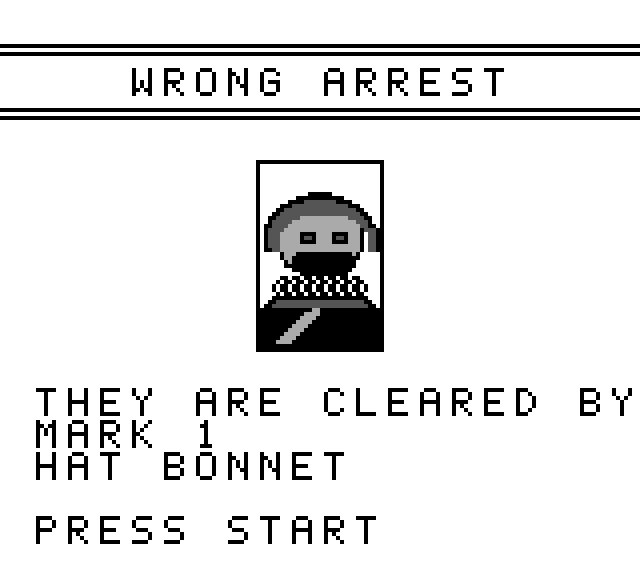
A wrong arrest does not just say no. It names the mark that clears them — "THEY ARE CLEARED BY MARK 1: HAT BONNET". The game can always do this, because the case came with a proof.
What you get
- 160 certified cases — 40 in each of four tiers, every one proved before it shipped.
- 500 composable suspects, assembled on the hardware from 19 hand-authored parts.
- 8 cases to a docket, 3 arrests to spend.
- Music and sound on the Game Boy's own four channels. A mute toggle that is honoured.
- A real .gb file — a standard 32,768-byte ROM with no mapper, no save chip and no BIOS dependency.
The free demo is five cases, in the browser, ending in the tier where a witness starts lying — which is where the buying decision is honestly made. The download is the whole cartridge.
Honest notes
- It is a turn-based logic game on a 4 MHz CPU. There is no action in it.
- The cartridge holds a fixed library of 160 certified cases, not an infinite runtime generator. It is a generated library rather than a generating game — the proof is decided by exhaustive search, which is nothing offline and impossible at 4 MHz.
- This cartridge is verified frame-by-frame in an accurate emulator against a reference renderer. It has not been run on physical hardware, because we do not own any, and this page does not claim otherwise. What is claimed is the format: no-MBC, valid header, nothing exotic.
- The screen is 160×144 in four shades of grey, because it is a Game Boy game rather than a game styled after one.
Made by Core Systems Asset Factory. AI-assisted and tagged truthfully: code yes, graphics yes, text yes, sounds no — every sound is the DMG's own synthesiser driven by register writes, with no sample and no AI audio anywhere in the chain.
More Game Boy cartridges from CSAF: PROOFMARK — the opposite mechanic, it hides a rule and shows you examples. And ANATOMIST, a Game Boy roguelike where a monster's shape is its stat block.
On an Analogue Pocket
The download is a standard Game Boy ROM with no mapper, so on an Analogue Pocket it runs through the openFPGA Game Boy core. We have not run it on Pocket hardware ourselves, and there is no .pocket build in the download.
Purchase
In order to download this game you must purchase it at or above the minimum price of $5.99 USD. You will get access to the following files:
Development log