Loop Core - Time Loop Engine, Persistent Knowledge & Loop Ledger for RPG Maker MZ
Majora’s Mask. Outer Wilds. Deathloop. 12 Minutes. The mechanic is easy to describe and miserable to hand-roll — because a time loop is not really about time. It is about bookkeeping: what snaps back, what survives, what the game must remember that the world has forgotten, and how the player is ever shown any of it.
Loop Core is that bookkeeping, plus the screen that makes it legible.
⚠️ Compatibility — the question you actually have
Tested against RPG Maker MZ with the stock scripts unmodified, verified by running the plugin in the real engine rather than only in tests.
Plugin Manager order:
LoopCore.js— The time-loop engine. The world resets, the player does not. Anchors, rewinds, carried knowledge and loop-gated events.LoopLedger.js— The Loop Ledger scene. Every loop a ring, every divergence a pin, everything known a constellation.LoopRewind.js— The rewind. A full-screen time-collapse shader that plays while the world snaps back to the anchor.
LoopCore is required; LoopLedger and LoopRewind are optional and can be switched off without breaking the loop.
Core methods extended — all 2 by saved-original prototype extension, none replaced: Game_System.prototype.initialize, Game_System.prototype.onAfterLoad.
Because nothing is clobbered, Loop Core co-exists with other plugins that patch the same seams, including large suites.
Three ideas, and that is the whole plugin
- Anchor — the moment a loop begins. Set it once. Every rewind returns the world to exactly this state.
- Rewind — put the world back. Switches, variables, self-switches, party position and condition, all as they stood at the anchor. Then the loop counter advances.
- Knowledge — what the player keeps. Facts, carried items, and the record of what they changed. A rewind cannot touch any of it.
The rule that keeps your project safe
Loop Core only ever touches the switch and variable ids you declare. Everything else in your project — every other plugin’s switches, every variable you use for something that is not the world — is not read, not written, and not rewound.
There is deliberately no “reset everything” mode. A loop plugin that clears state it does not own is a plugin that breaks the rest of your game on the second loop.
Loop-gated events, with no scripting at all
Point Loop counter variable at a spare variable and Loop Core keeps it equal to the current loop number. Now every ordinary Conditional Branch in your game can gate on the loop:
Conditional Branch: Variable [Loop] >= 3
For knowledge, the script conditions read like sentences:
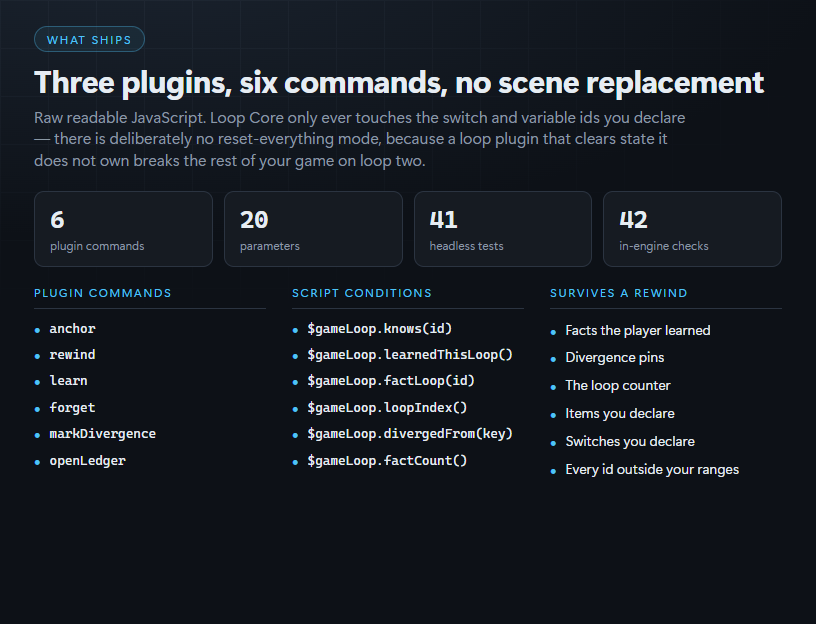
$gameLoop.knows('mayor_lies')$gameLoop.learnedThisLoop('mayor_lies')$gameLoop.factLoop('mayor_lies')$gameLoop.loopIndex()$gameLoop.divergedFrom('saved_the_smith')
Which gives you the pattern that carries a whole time-loop game:
Page 1, no condition — the mayor gives you the official story.
Page 2, condition $gameLoop.knows('mayor_lies') — you interrupt him, and he goes quiet.
Same NPC. Same map. The world reset; the conversation did not.
The Loop Ledger
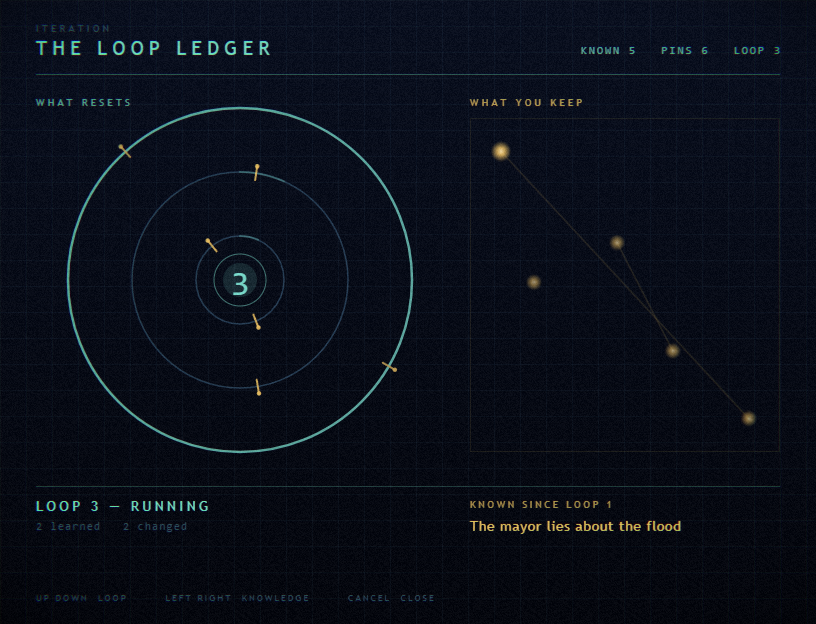
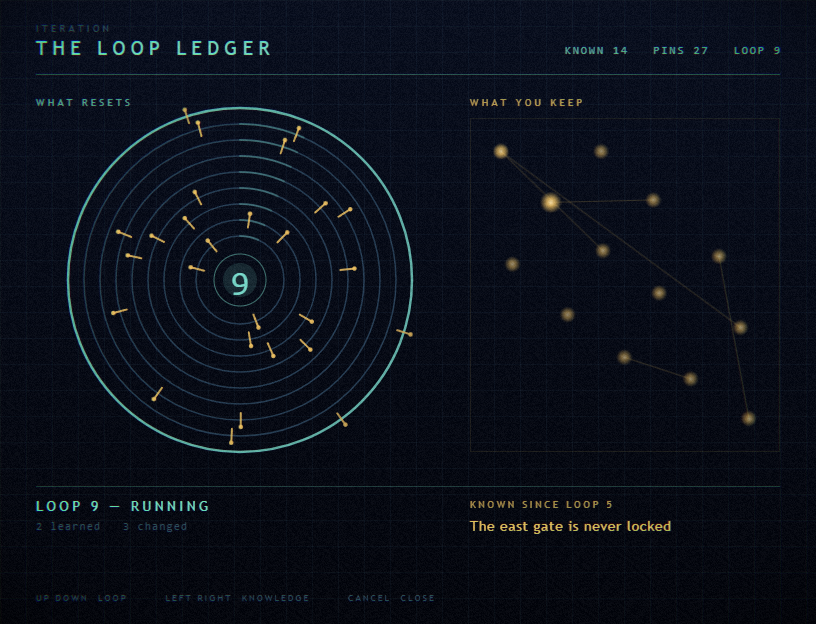
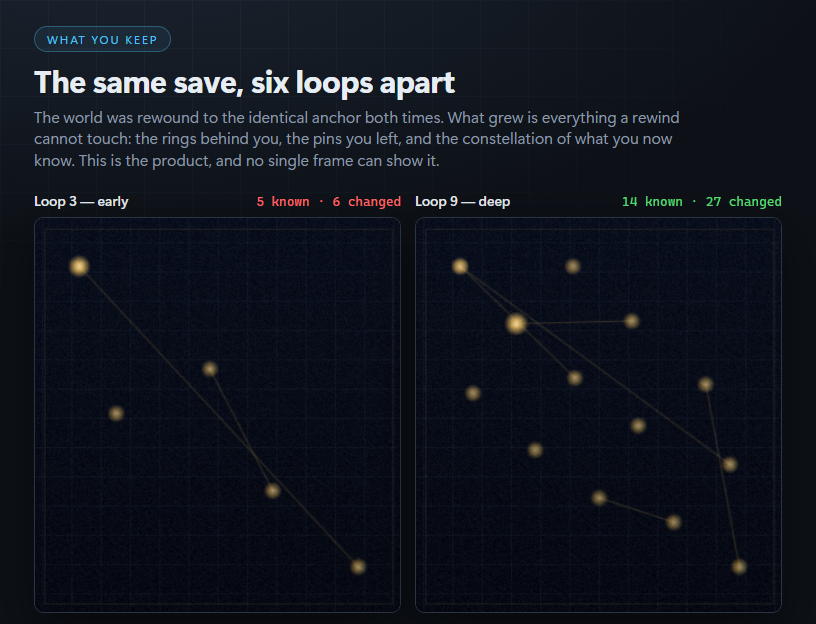
One command opens the scene, and the player sees the shape of their own repetition.
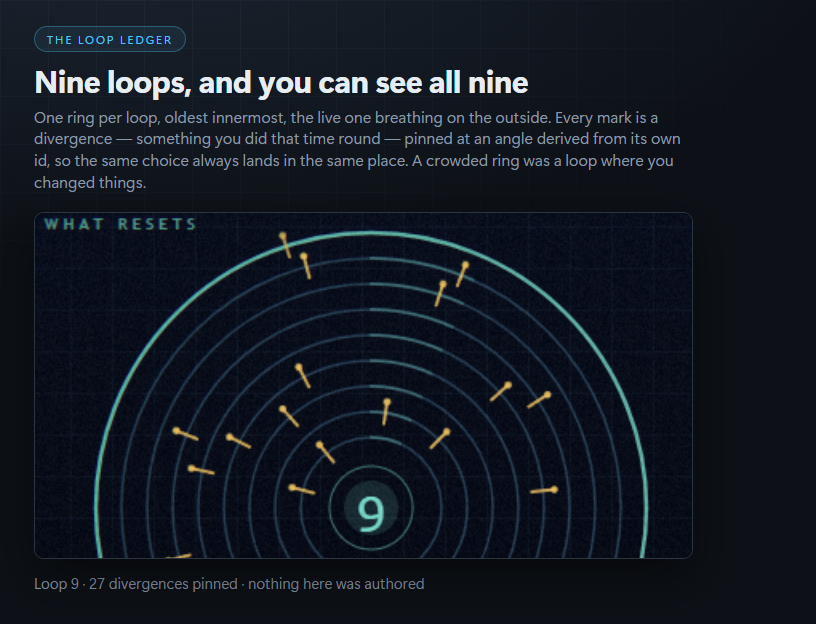
- The dial — one ring per loop, oldest innermost, the live one breathing on the outside.
- Pins — every divergence marked on its loop’s ring, at an angle derived from its own id, so the same choice always lands in the same place. A crowded ring was a loop where you changed things.
- The constellation — everything known, laid out from the facts’ own ids so the map is identical in every save on every machine. Facts learned in the same loop are joined, because the story that taught you one taught you the other.
You never author the Ledger. It is generated from the calls you already make.
It does not look like RPG Maker
There is no windowskin in this plugin, and no Window_ class at all. The Ledger is drawn entirely from scratch: tracked uppercase display type, monospaced numerals, a procedural graticule backdrop, and rings that sweep in on a stagger. Measured in the real engine, the scene draws zero RPG Maker windows.
Over the whole scene sits a real fragment shader — chromatic separation that grows toward the edges, a drifting scanline, film grain and a vignette. And the rewind itself is a full-screen time-fold: the image is dragged toward the centre along a spiral, torn into rings that slip against each other, and split per colour channel as it goes. RPG Maker’s own transitions are fades and picture wipes. A time loop should not reset behind a fade to black.
Saves are the part everyone gets wrong
Loop Core stores its state in a versioned record with a migration path, and it stores your fact ids in arrays, never as object keys. That is not a style preference. An id taken from author text can be __proto__, which as an object key sets the prototype instead of storing a value — and the resulting object breaks RPG Maker’s own save serialiser for your entire game, not just for this plugin. The test suite has a case asserting exactly that, and a second script that deliberately breaks the data model to prove the case still fires.
- Adding Loop Core to an existing save works.
- Removing it later leaves the rest of the save intact.
- Saving mid-loop and reloading rewinds correctly, because the anchor is part of the record.
Built and verified
- 41 headless tests and 42 checks in the real MZ runtime, all green, every suite run separately.
- 2 draw calls per frame, 0 texture uploads, 0 bitmap redraws, 0 window refreshes, 0 display-object growth — measured over 400 stepped frames. The Ledger draws once and animates sprite properties only.
- Every per-frame code path is statically proven to allocate nothing, with the scanner proven to fire against a sabotaged copy of each one.
- Patches applied by prototype extension with the original saved and called. Nothing in the engine is replaced.
- The rewind visual degrades safely: if the shader will not compile on a player’s hardware, the rewind still happens, immediately and correctly, with no visual.
What ships
Three plugins — the engine, the Ledger scene, and the rewind effect — as raw, readable, uncompressed JavaScript. Six plugin commands, twenty parameters, a full Readme, and a commercial licence. No new database entries, no notetags, no map changes.
Also from CSAF
Chronicle Core — branching quests, foreclosed choices and faction consequence. A choice closed off in one loop can be reopened in the next: Chronicle tracks what your choices do, Loop Core decides which of it survives the reset.
Cipher Core — an invented written language your players actually learn — glyphs stay untranslated until deduced, then read as their meaning forever.
Full catalogue: csaf.itch.io
More RPG Maker MZ plugins from CSAF
Chronicle Core — a quest journal that records the choices the player actually made.
Cipher Core — ciphers and lock puzzles that are real puzzles, not a locked door with a switch.
Aperture Core — a photography and observation system — pay what you want.
Voyage Core — overworld travel with routes, cost and risk instead of a teleport menu.
We also build editor tooling for Unity, Unreal and GameMaker — the full CSAF catalogue.
Purchase
In order to download this tool you must purchase it at or above the minimum price of $9.09 USD. You will get access to the following files:
Development log

Leave a comment
Log in with itch.io to leave a comment.