Aperture Core - In-Game Camera for RPG Maker MZ
A downloadable asset pack
Screenshot plugins are free. This is not one.
A screenshot plugin writes a PNG to the player's hard drive, and nothing in your game ever knows it happened. Aperture Core gives the player a lens.
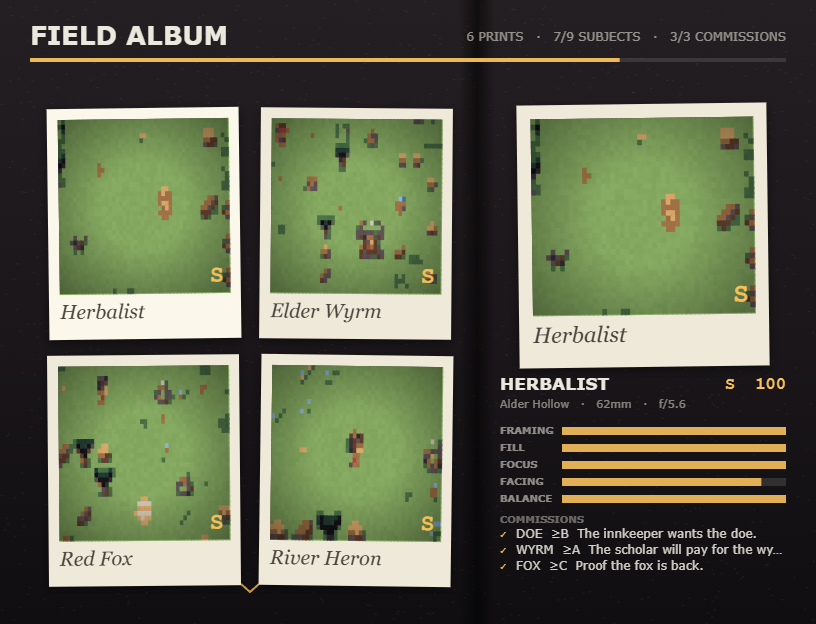
They frame a shot through a real viewfinder, rack focus, choose an aperture, and press the shutter — and the engine judges the photograph. What was in it. How it was composed. Whether the subject was sharp. Whether it was looking at them. The result is a developed print that lands in an album, satisfies photo commissions, and can be read back by your events.
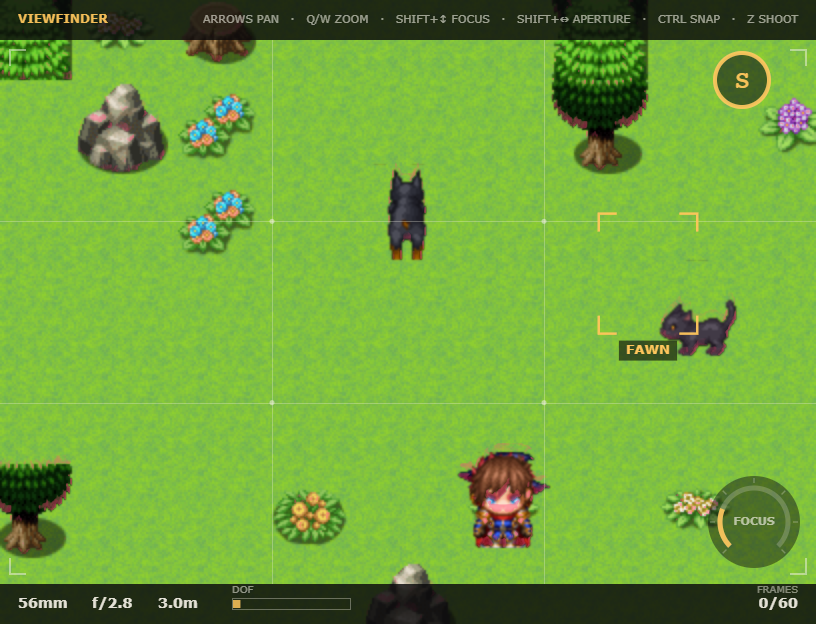
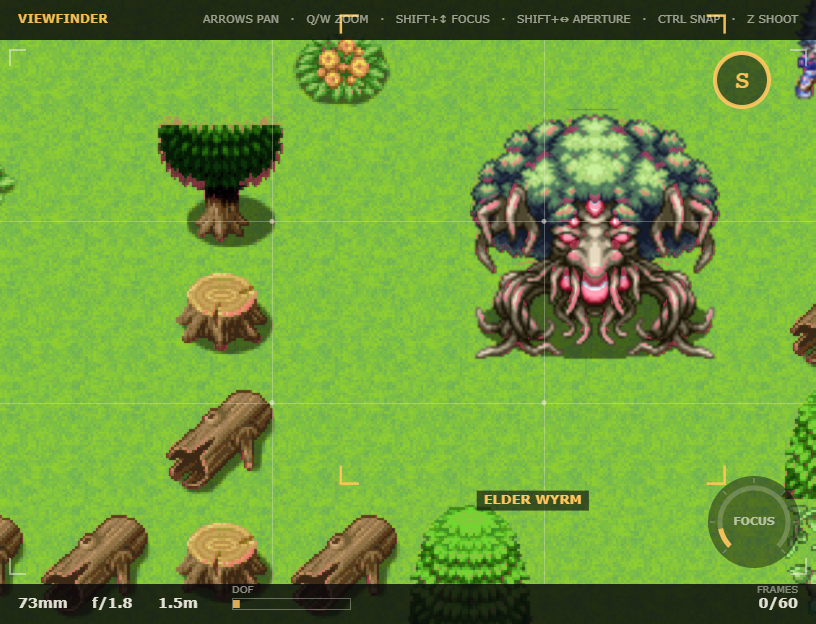
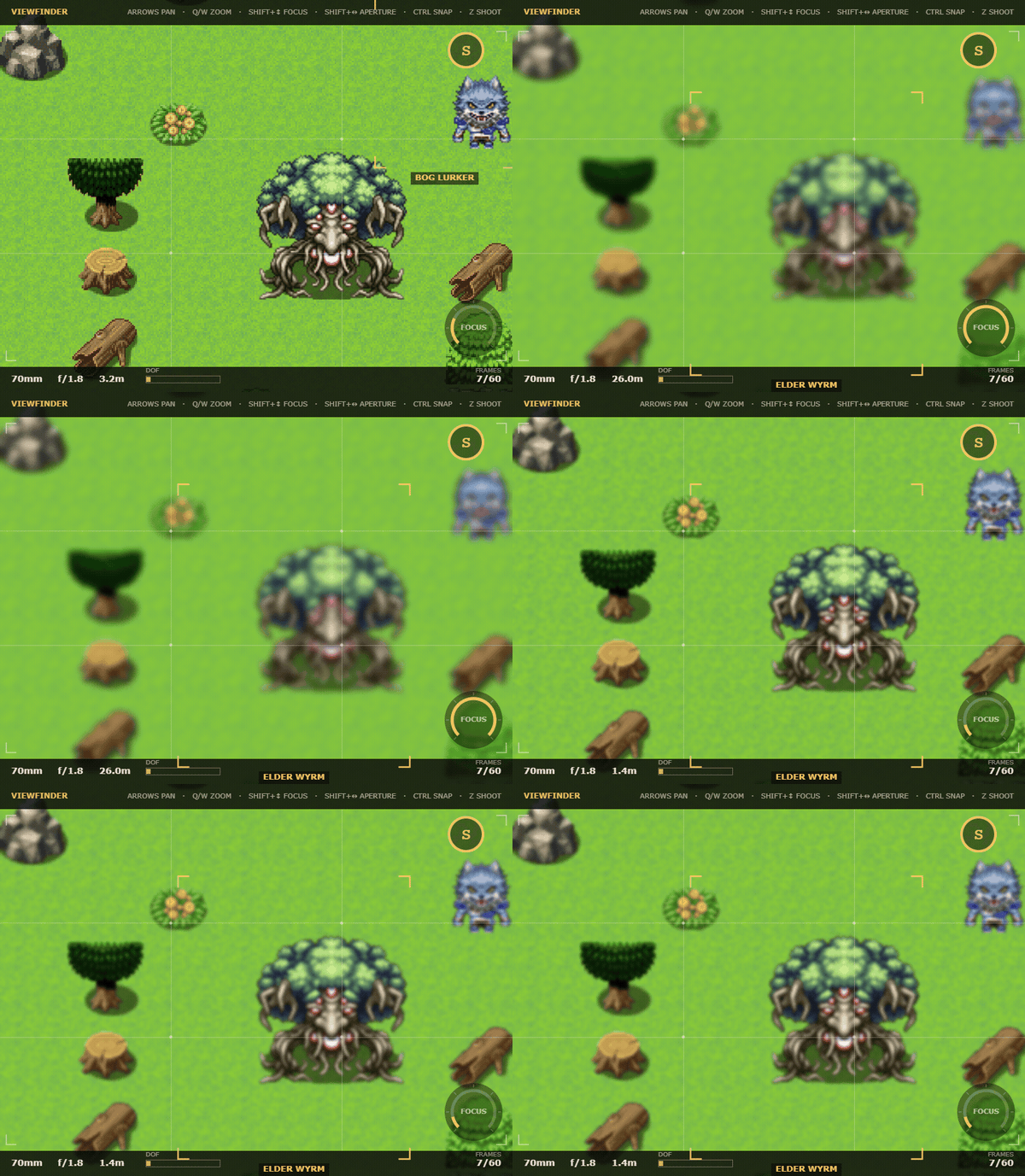
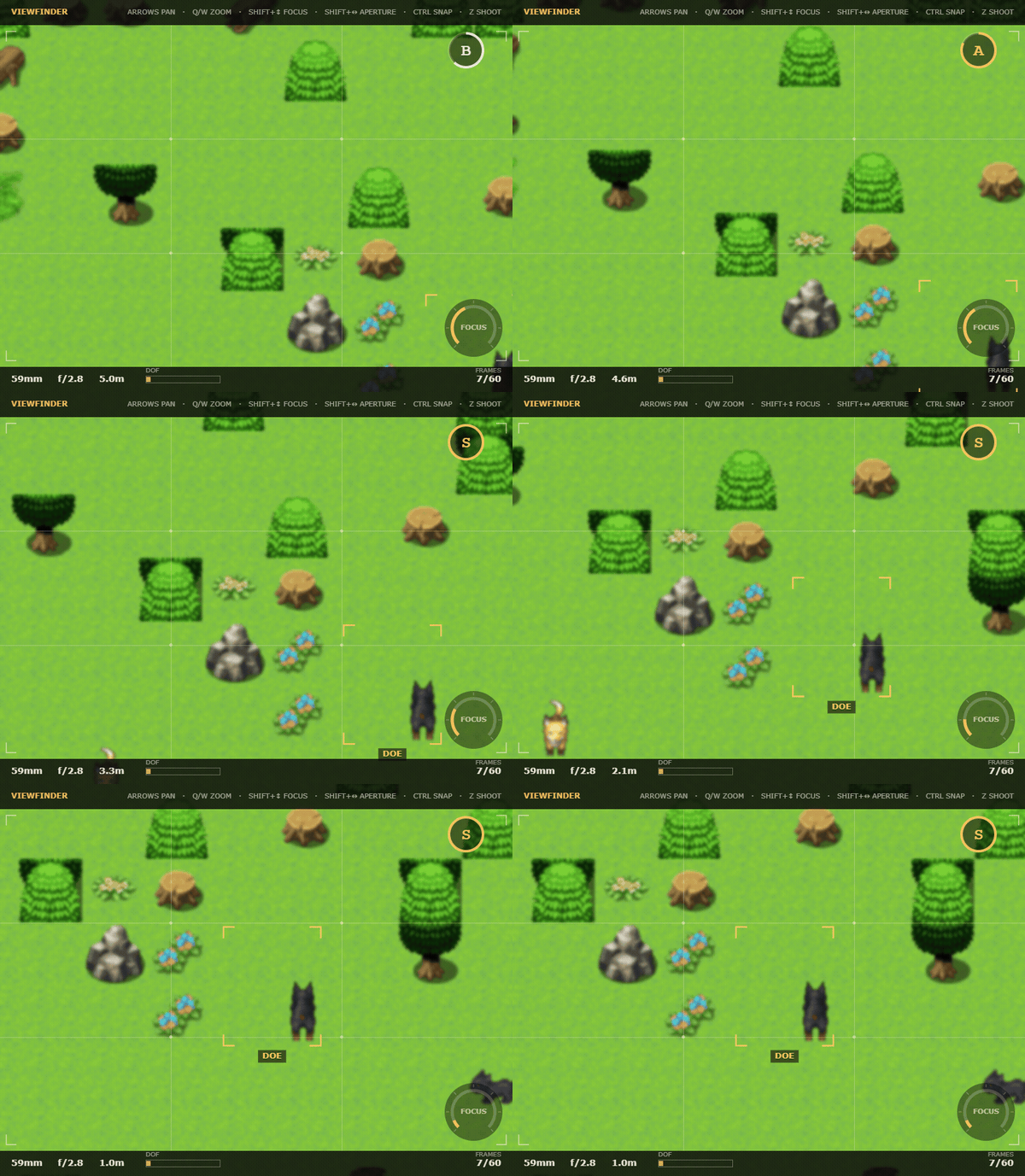
The viewfinder is the product
- Rule-of-thirds guides that fade in while you are moving and out when you settle
- Autofocus brackets that snap to the subject and name it
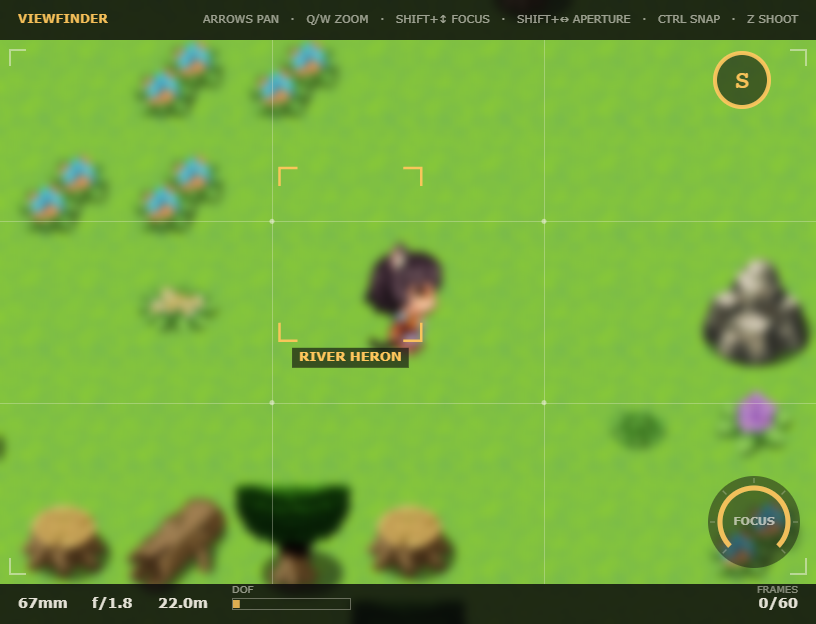
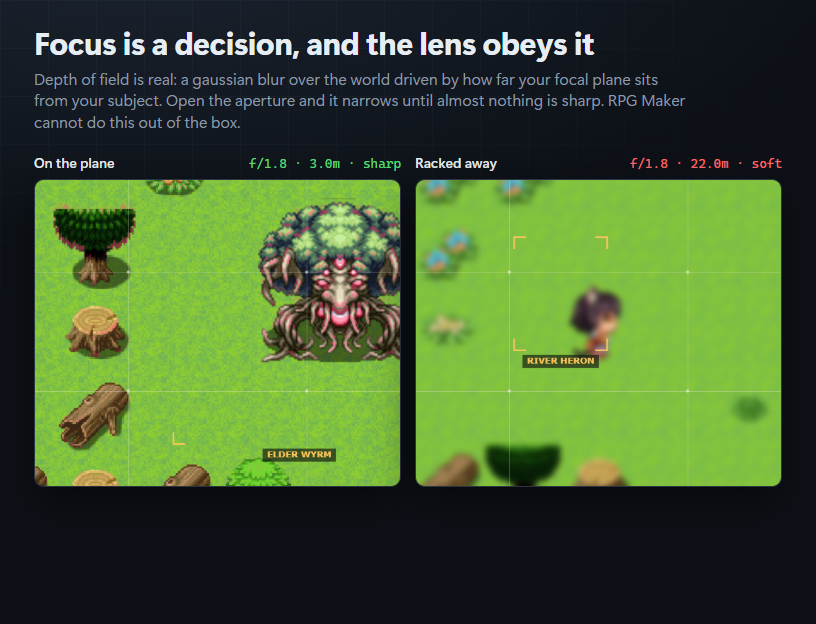
- Real depth of field — a genuine gaussian blur over the world, driven by how far your focal plane sits from your subject. RPG Maker cannot do this out of the box
- Focus peaking — the mirrorless-camera trick of painting in-focus edges in a hot colour, written as a GLSL shader
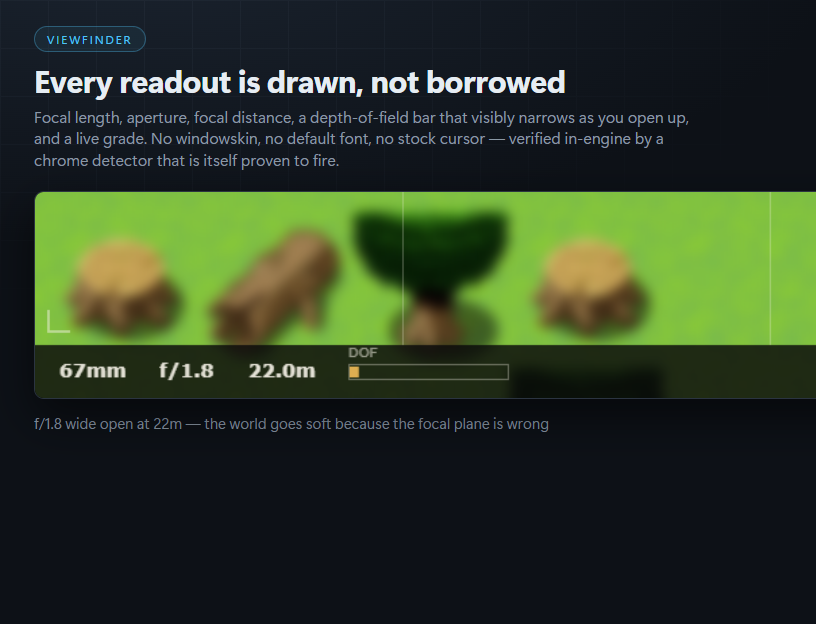
- A depth-of-field bar that visibly narrows as you open the aperture, so the mechanic teaches itself
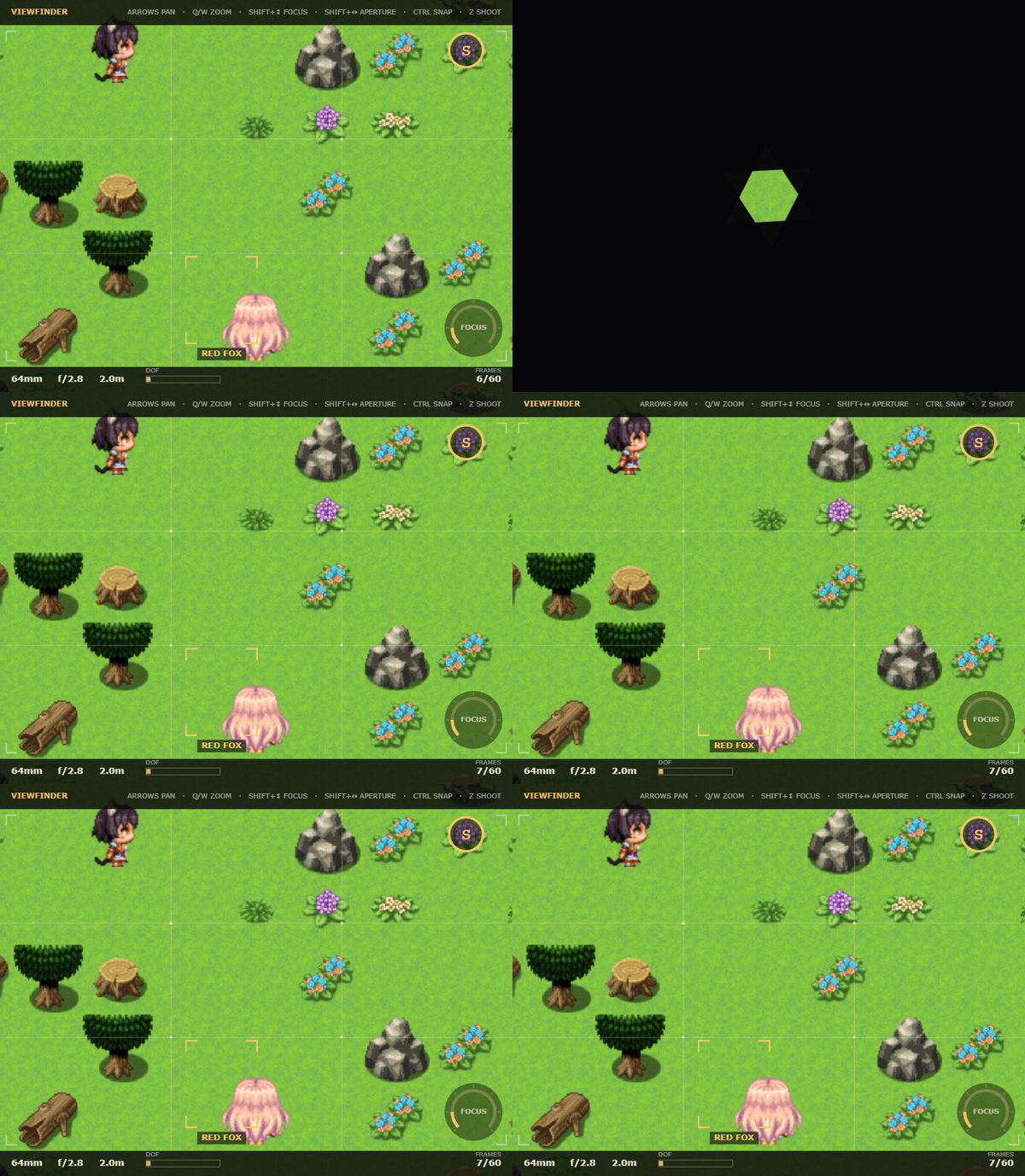
- A leaf shutter that actually closes, with a flash and a frame freeze
- Six aperture stops, f/1.8 to f/11, and a focal length readout in millimetres
There is no windowskin anywhere in it. No default font, no default layout, no stock cursor. Every mark on screen is drawn by the plugin, and an automated chrome detector — itself proven to fire on injected stock chrome — verifies that in the real engine on every build.
What the engine scores
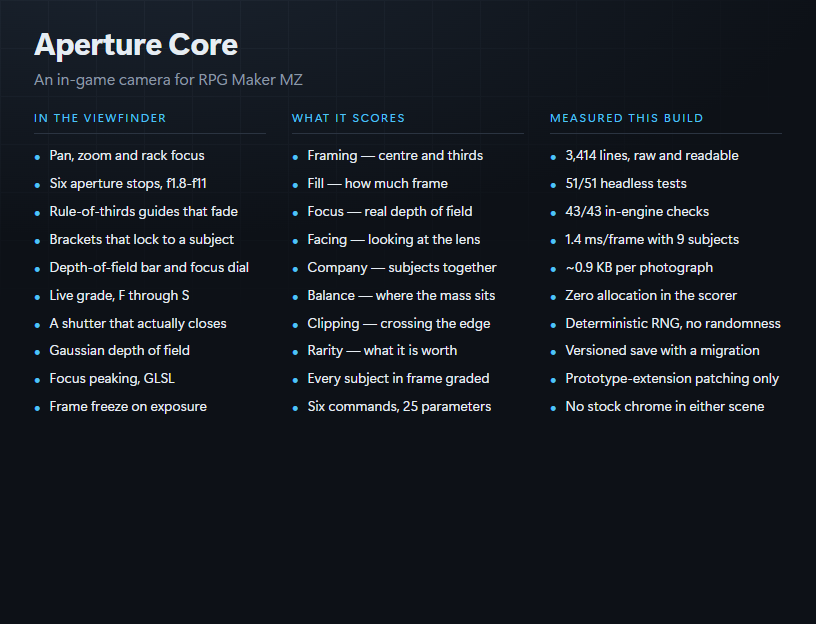
| Framing | How near the subject sits to a power point — the frame centre, or one of the four rule-of-thirds intersections. A deliberate off-centre composition scores as well as a centred one, which is the whole reason the rule exists. |
| Fill | How much of the frame the subject occupies. A speck on the horizon and a cropped nose both score badly. |
| Focus | Distance from the focal plane, against a depth of field derived from your aperture and focal length. Wide open on a long lens you have almost nothing. |
| Facing | A creature looking at the lens is a better photograph than the back of its head. |
| Company | A second and third subject enrich a photograph. A sixth makes it a crowd. |
| Balance | Where the weighted mass of the shot sits in the frame. |
Every subject in frame is graded, not just the best one. A photograph of a doe with her fawn beside her is a photograph of the fawn too — and it satisfies a commission for either.
One notetag is the entire authoring burden
Put this in the note box of any event. There is no separate database, no per-map registry, no setup event:
<photo: forest_wolf, Grey Wolf, size=1.6, rarity=3, points=180>
Photo requests
A request is a commission: photograph this subject, at least this well. The moment a qualifying print is filed, the request completes and your events can read it back into a switch. Read a subject's best score into a variable and gate dialogue, prices or quests on how good a photographer the player actually is.
A commission for something already photographed well enough completes the instant it is issued — otherwise the player is told to go and photograph a wolf while holding a perfect photograph of a wolf.
Why your save file does not explode
This is the trap every in-game camera falls into, so it was designed out first.
A photograph is not stored as an image. Each print keeps a small indexed-colour thumbnail — 48×36 in 16 colours is about 900 bytes — plus the shot's descriptor: where the camera was, what was in frame, how it scored. Sixty photographs cost roughly 55 KB. A single PNG data URI would have cost more than that on its own, and there would have been sixty of them.
The print you see in the album is re-developed from that data every time it is displayed. That is also why prints look like prints rather than screenshots: the 16-colour film stock is the aesthetic, not a compromise.
Built to be lived with
- Raw, readable, uncommented-out JavaScript — 3,414 lines you can read, debug and extend
- Every core method patched by prototype extension, original saved and called. Nothing overwritten
- Window classes that appear elsewhere in your game are never restyled on the prototype — installing this does not change the look of anything outside its own scenes
- The album is saved as plain data, never a class instance, so a save still loads if you later disable the plugin
- Nothing calls
Math.random(). All variation is seeded, so a print develops identically on every machine - Zero allocation in the per-frame scorer, enforced by a static scan that is proven to fire against sabotaged source
- 51/51 headless tests and 43/43 checks inside the real engine, including a save round-trip through
JsonEx - Measured at 1.4 ms/frame with nine live subjects — about 8% of a 60fps budget
Requirements
RPG Maker MZ, any recent version. Three plugin files, no dependencies. If a machine's graphics driver refuses to compile the focus-peaking shader, the camera silently continues without it — the scene never fails.
Also from CSAF for RPG Maker MZ
Building a collect-a-thon? Aperture Core pairs directly with these — photograph what you catch:
- Chimera Core — creature genetics, breeding and box storage
- Chimera Field — spawn tables, rarity and variants
- Chimera Battle — type matchups and battle behaviour
- Chronicle Core — the consequence engine under your quest log
- Bazaar Core — supply, demand and depleting stock
- Verdict Core — evidence, contradictions and case files
- Sigil Core — spell art generated from your own database
Aperture Core is AI-assisted software. The code is LLM-written and the store art is generated; this is disclosed truthfully in the listing's AI classification.
Purchase
In order to download this asset pack you must purchase it at or above the minimum price of $18 USD. You will get access to the following files:
Development log