Verdant 21 — School Tileset for RPG Maker MZ, Tiled & Godot: Classroom, Corridor, Gym & Yard [16x16]
A downloadable asset pack
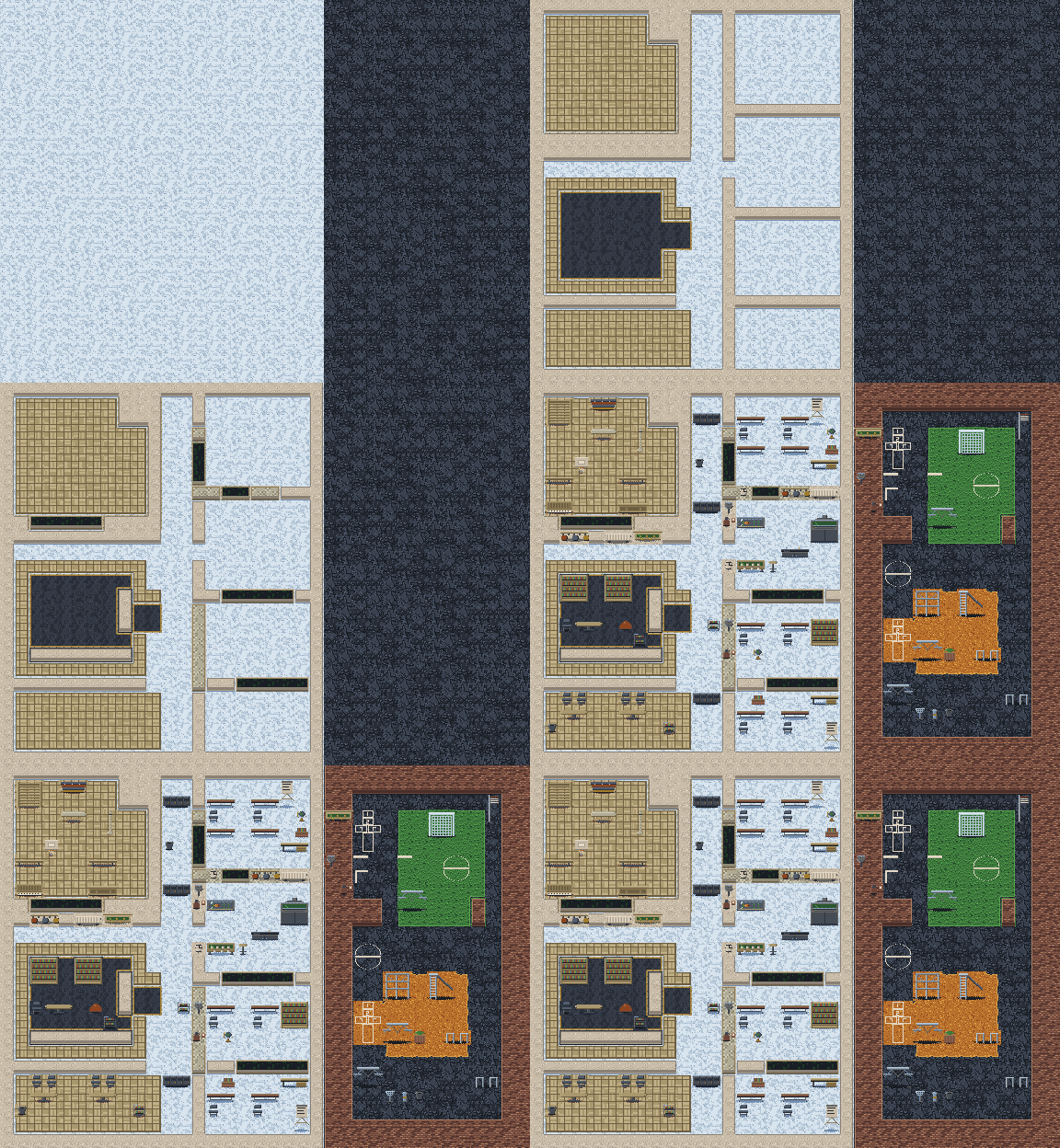
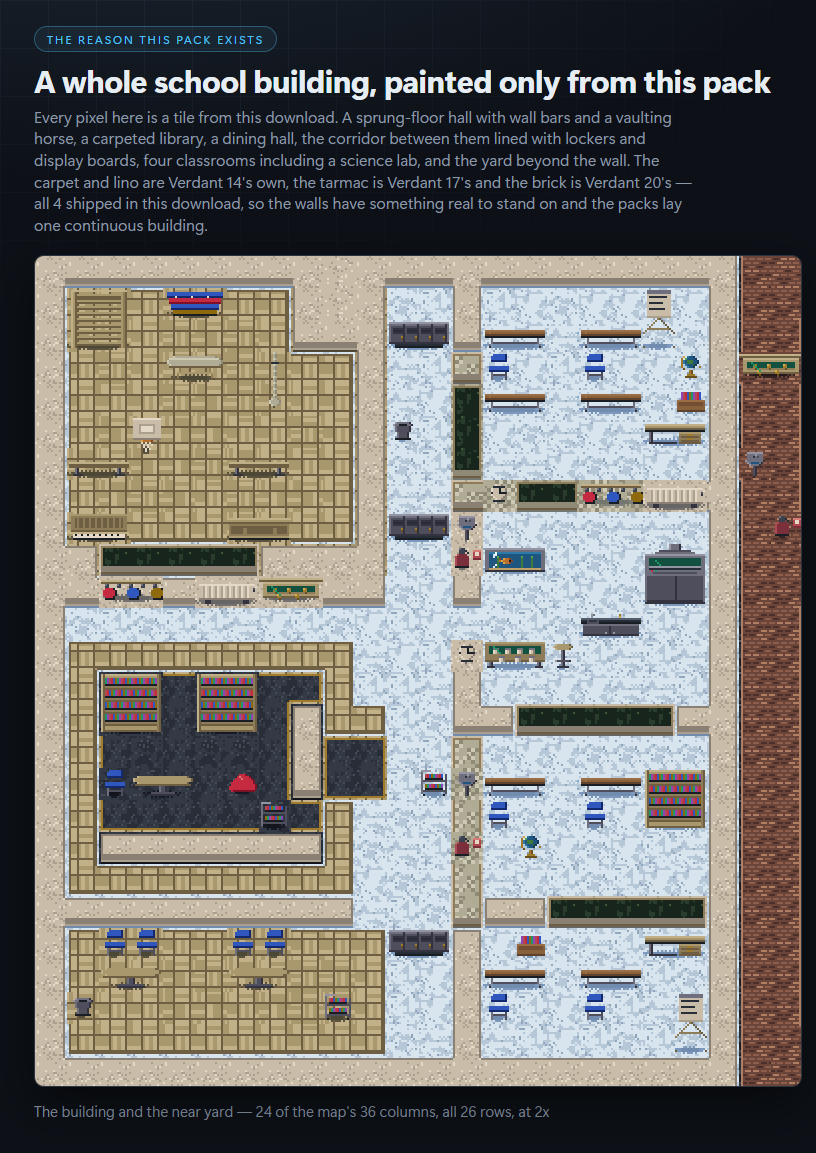
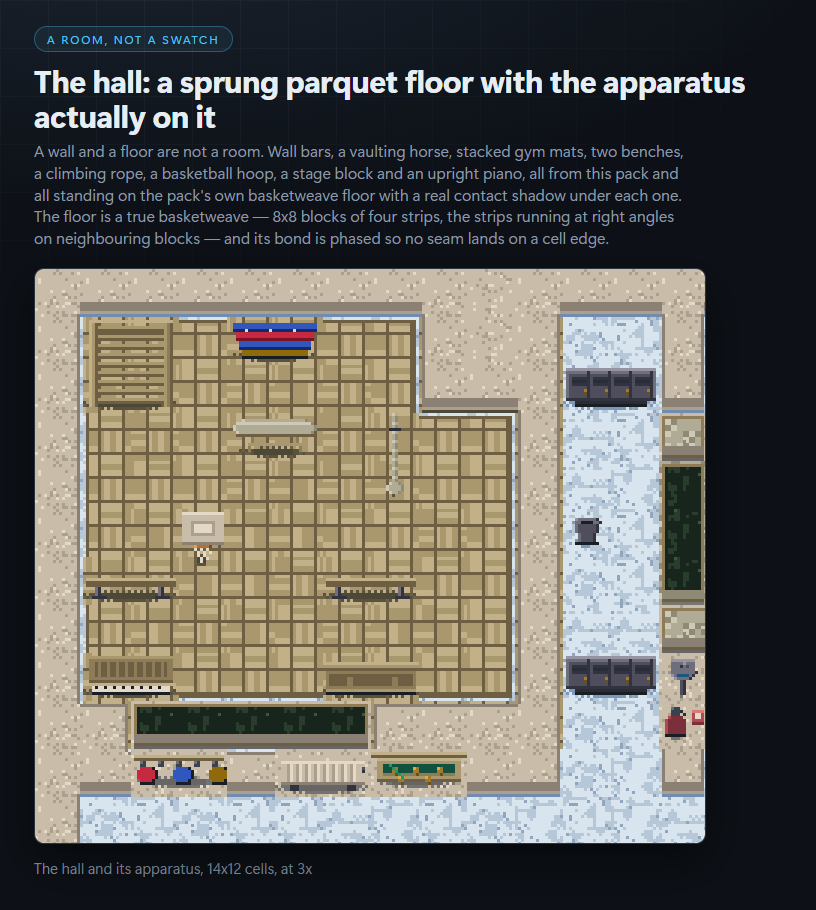
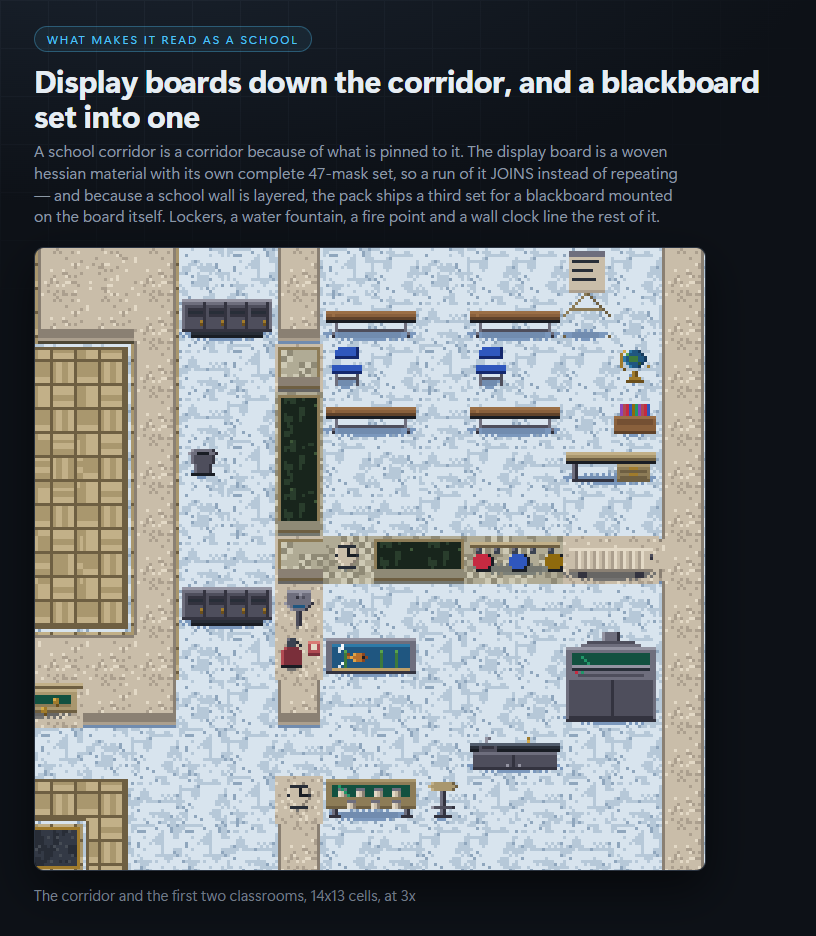
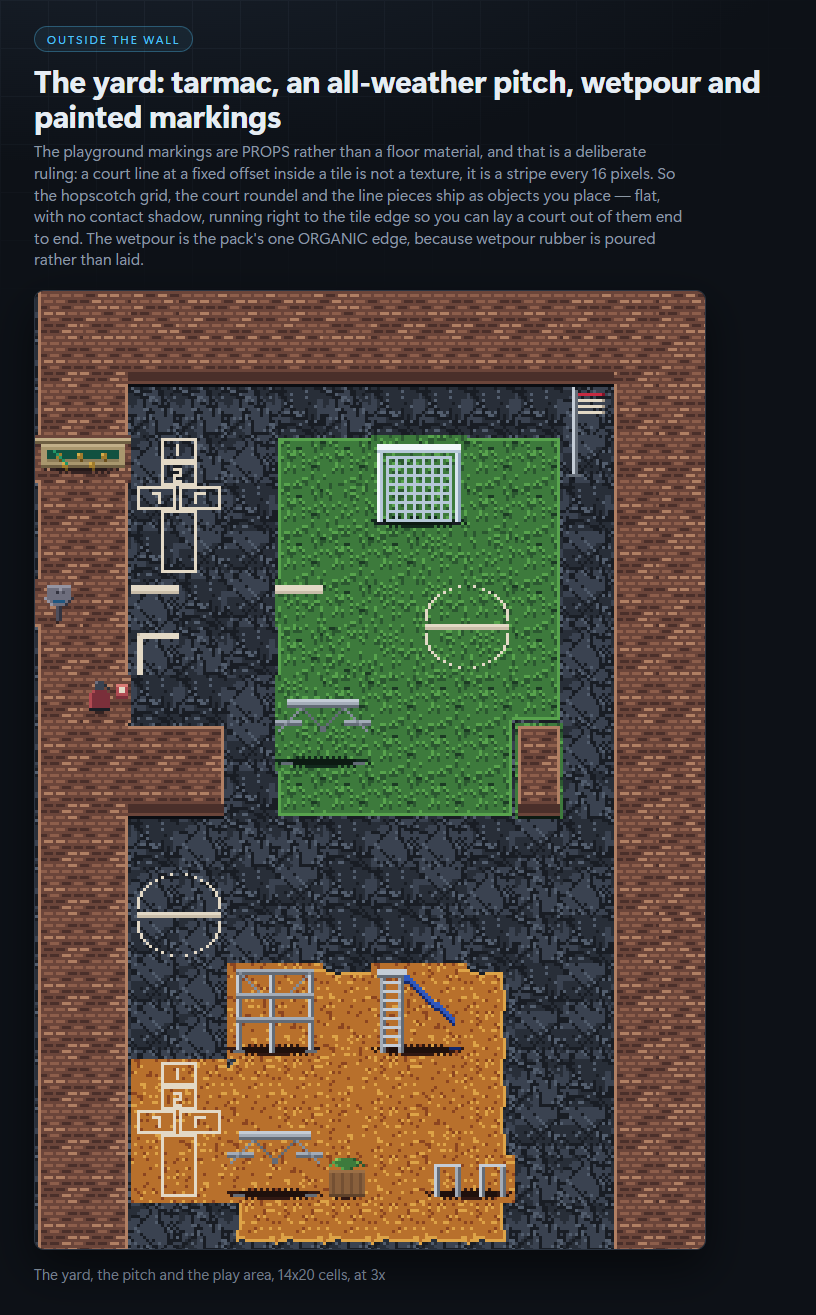
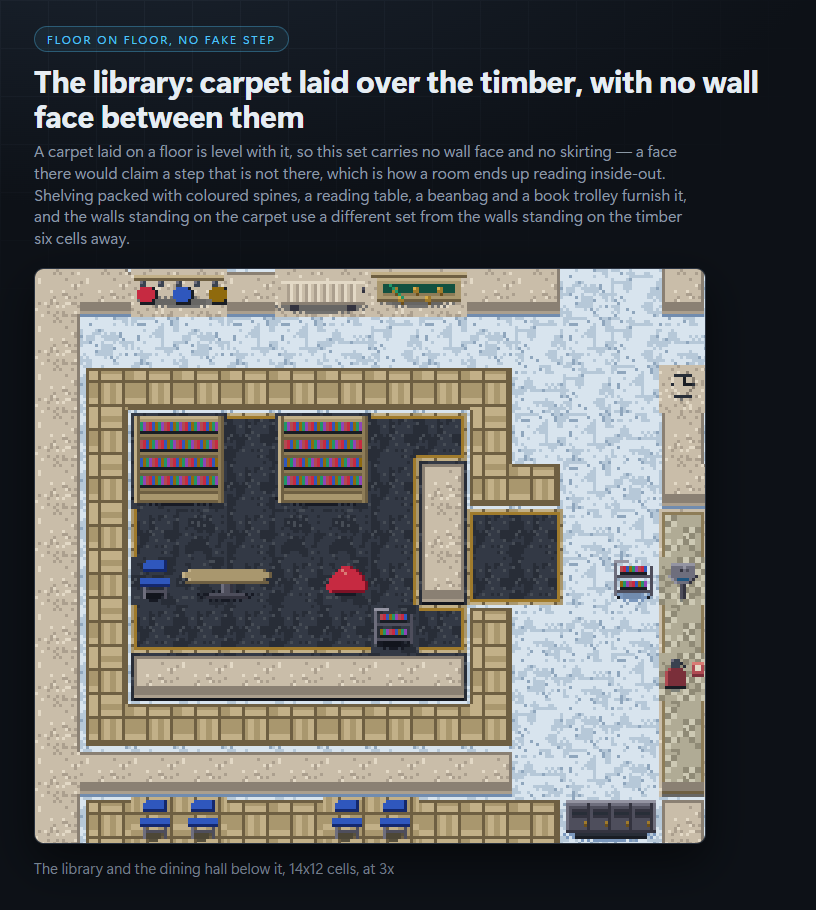
783 tiles at 16x16. A whole school: a sprung-floor hall, a carpeted library, a dining hall, the corridor between them lined with lockers and display boards, four classrooms including a science lab, and the yard outside with an all-weather pitch, poured wetpour and painted court markings.
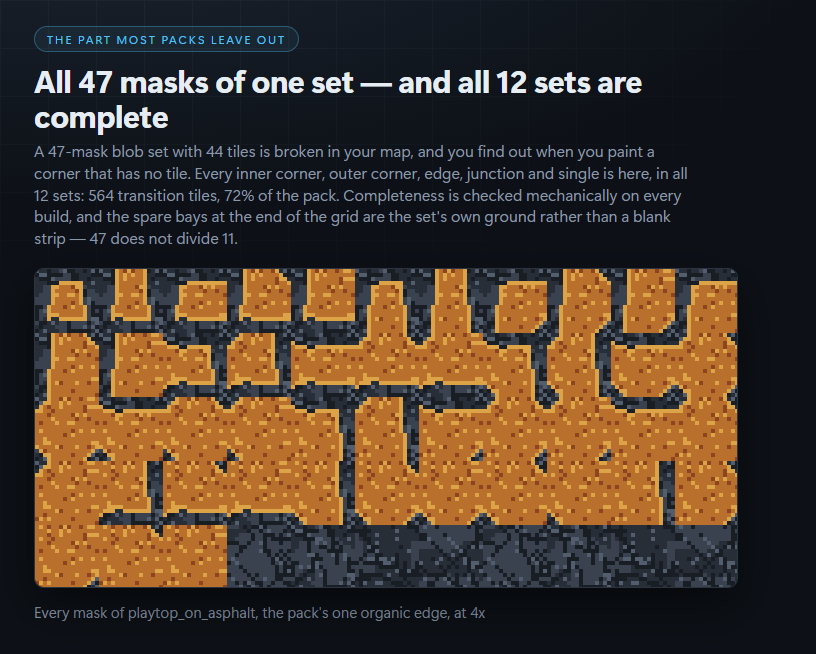
564 of those tiles — 72% of the pack — are autotile transitions, because the transitions are the part that takes the time and the part most packs leave out.
What is in it
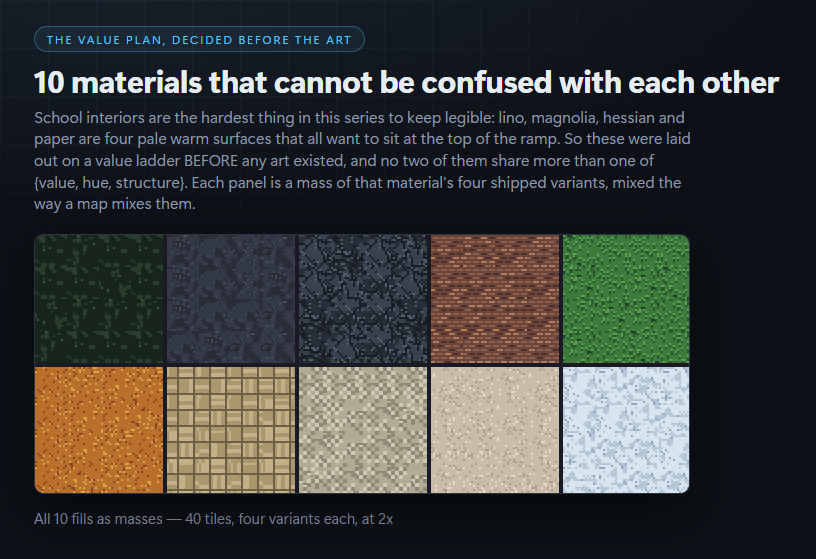
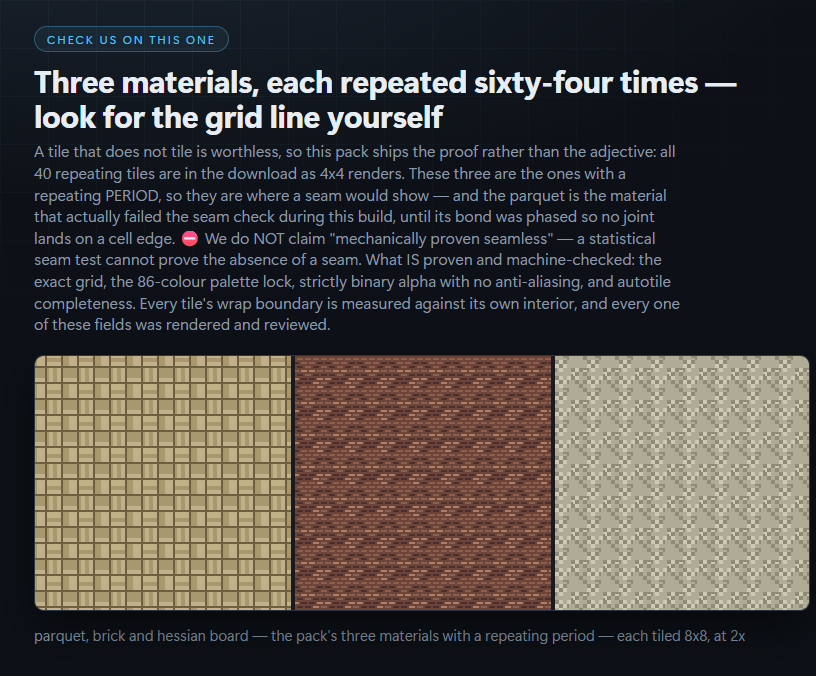
- 40 fill tiles — 10 materials, 4 seamless variants each.
- 12 complete 47-mask autotile sets = 564 tiles. Every inner corner, outer corner, edge, junction and single. A 47-mask set with 44 tiles is broken in your map, so completeness is checked mechanically on every build.
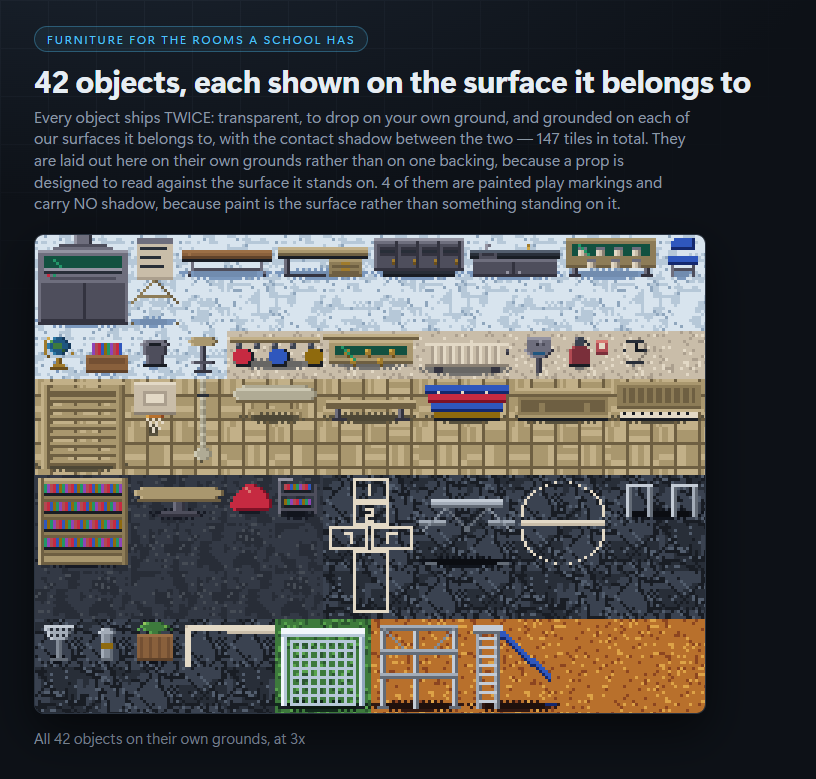
- 42 objects across 147 prop tiles — every object ships transparent, to drop on your own ground, and grounded on each of our surfaces it belongs to, with the contact shadow between the two.
- 2 animated sets = 32 tiles: a classroom fish tank and a flagpole.
- A finished sample map — 36x26 cells — as a PNG, as JSON with
every cell named by tile id, and as a Tiled
.tmx. - Importers for three engines: an RPG Maker MZ A2 autotile sheet plus B/C/D/E
object sheets, one Tiled
.tsxper group, and a Godot 4.tresTileSet. - 40 4x4 proof renders — every repeating tile, tiled sixteen times, so you can look for the grid line yourself.
The play markings are objects, not a floor material
A court line at a fixed offset inside a tile is not a texture — it is a stripe every 16 pixels. So the hopscotch grid, the court roundel and the line pieces ship as 4 dedicated multi-cell objects you place: flat, with no contact shadow (paint sits on the surface rather than standing on it), and running right to the tile edge so you can lay a court out of them end to end.
It composes with the rest of the series
4 of the 10 materials are shipped straight from earlier Verdant packs, generated by their own modules rather than copied: the carpet and corridor lino from Verdant 14, the playground tarmac from Verdant 17 and the Victorian brick from Verdant 20. They are in this download, so the pack stands alone — and if you own any of those, this is literally the same material, so the two packs lay one continuous building.
The autotile sets
Every set is named X_on_Y, and the name states what is underneath X. In an
autotiled map only one side of a boundary is ever drawn — the material laid on top — so "the set
between a wall and a floor" has two possible answers and "the set for a wall lying on a floor" has
exactly one.
emulsion_on_lino— hard edge, with a wall face and a skirtingemulsion_on_carpet— hard edge, with a wall face and a skirtingemulsion_on_parquet— hard edge, with a wall face and a skirtingpinbd_on_emulsion— hard edge, with a wall facechalk_on_emulsion— hard edge, with a wall facechalk_on_pinbd— hard edge, with a wall faceparquet_on_lino— hard edgecarpet_on_parquet— hard edgebrick_on_asphalt— hard edge, with a wall face and a skirtingbrick_on_astro— hard edge, with a wall face and a skirtingastro_on_asphalt— hard edgeplaytop_on_asphalt— organic edge
What is proven, and what is not
Everything below was checked mechanically on the exact files in this download:
- Exact grid — every tile exactly 16x16, every sheet an exact multiple of it.
- Palette lock — every opaque pixel inside the declared 86-colour palette.
- No anti-aliasing — alpha is strictly binary. Nothing has been scaled, filtered or blended.
- Autotile completeness — all 564 mask slots across 12 sets.
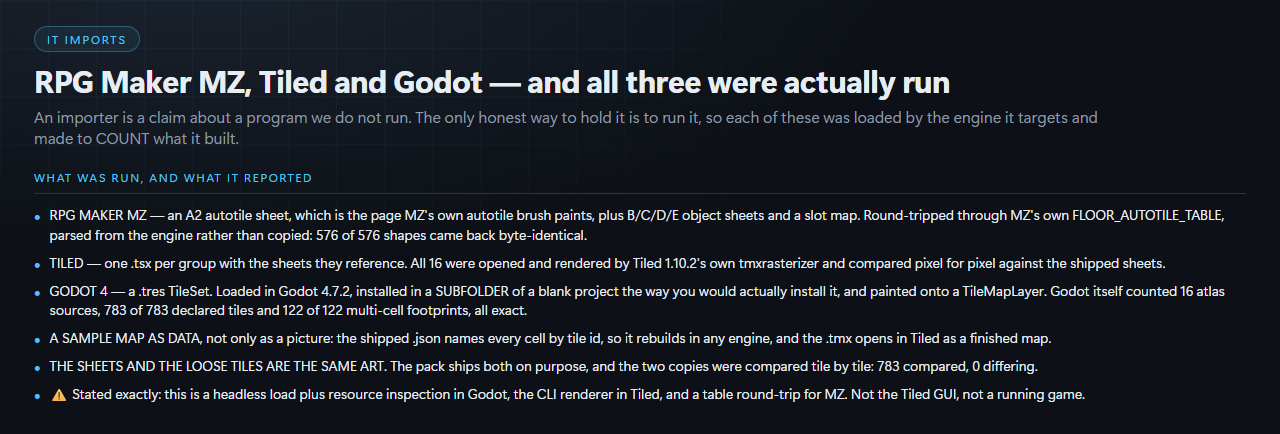
- The sheets match the loose tiles — the pack ships its art twice and the two copies were compared tile by tile: 783 compared, 0 differing.
- The importers were run. The Godot
.treswas loaded in Godot 4.7.2, installed in a subfolder of a blank project the way you would actually install it, and painted onto a TileMapLayer — Godot itself counted every atlas source, all 783 tiles and every multi-cell footprint. The.tsxfiles were rendered by Tiled 1.10.2's own tmxrasterizer and compared pixel for pixel against the shipped sheets. The MZ A2 sheet was round-tripped through RPG Maker MZ's own autotile table, parsed from the engine rather than copied, and every shape came back byte-identical.
What is NOT claimed: "mechanically proven seamless." Every tile's wrap boundary is
measured against its own interior and every 4x4 repetition is rendered and reviewed — but a
statistical seam test cannot prove the absence of a seam, and this series will not say it can. The
40 proof renders are in proof/repetition/; look for the grid line yourself.
How to paint it
Ground first, with no holes in it. Lay lino across the interior and tarmac across the yard, then paint each material on top of the last — the hall and library floors onto the lino, the carpet onto the library floor, the walls onto whichever floor they stand on, the boards onto the walls. If you paint it the other way round you get a bright line of the wrong floor around every wall. The shipped sample map is built in twelve layers and is the worked example.
Also in this series
- verdant institutional interiors — the institutional interiors this pack's carpet and lino come from
- verdant urban decay — the modern derelict sibling this pack's playground tarmac comes from
- verdant prison — the prison sibling this pack's Victorian brick comes from
Licence and AI disclosure
Commercial use permitted, unlimited projects, no attribution required. You may not resell or redistribute the pack itself.
The graphics are generated programmatically by a procedural pixel-art engine written for this series — no diffusion model and no training dataset is involved in producing any pixel. The generator's source was written with AI assistance, and this listing carries itch's Generative AI tag on that basis.
Purchase
In order to download this asset pack you must purchase it at or above the minimum price of $12.99 USD. You will get access to the following files:
Development log
Leave a comment
Log in with itch.io to leave a comment.