Chorograph — the explored world, redrawn as an inked survey map
A downloadable asset pack
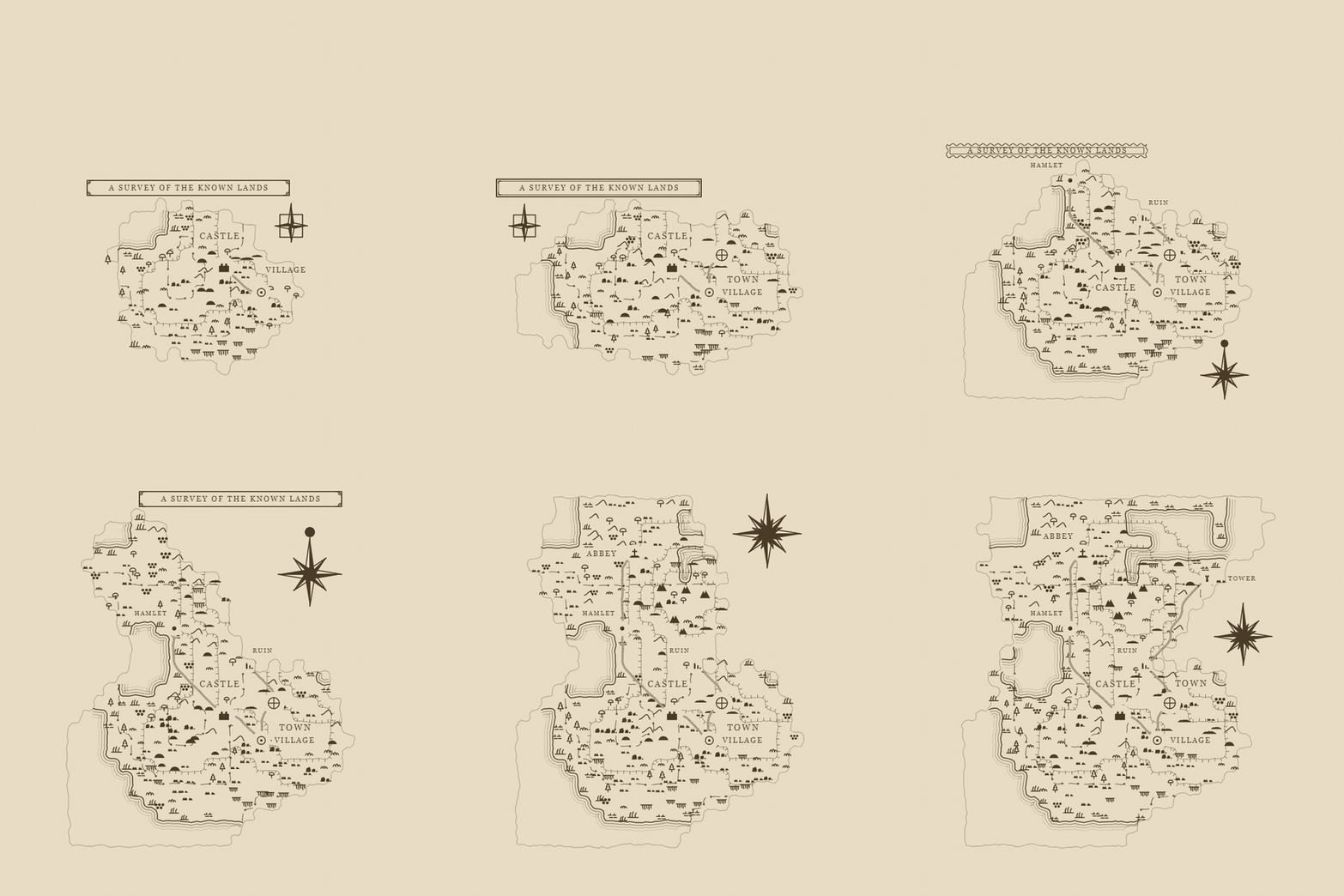
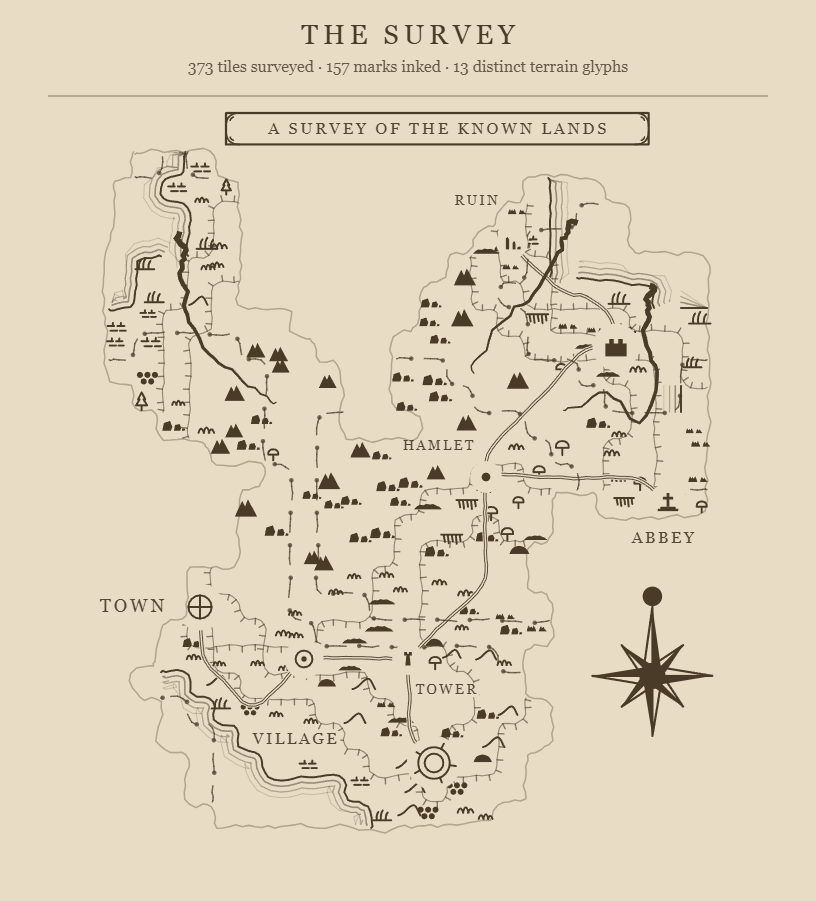
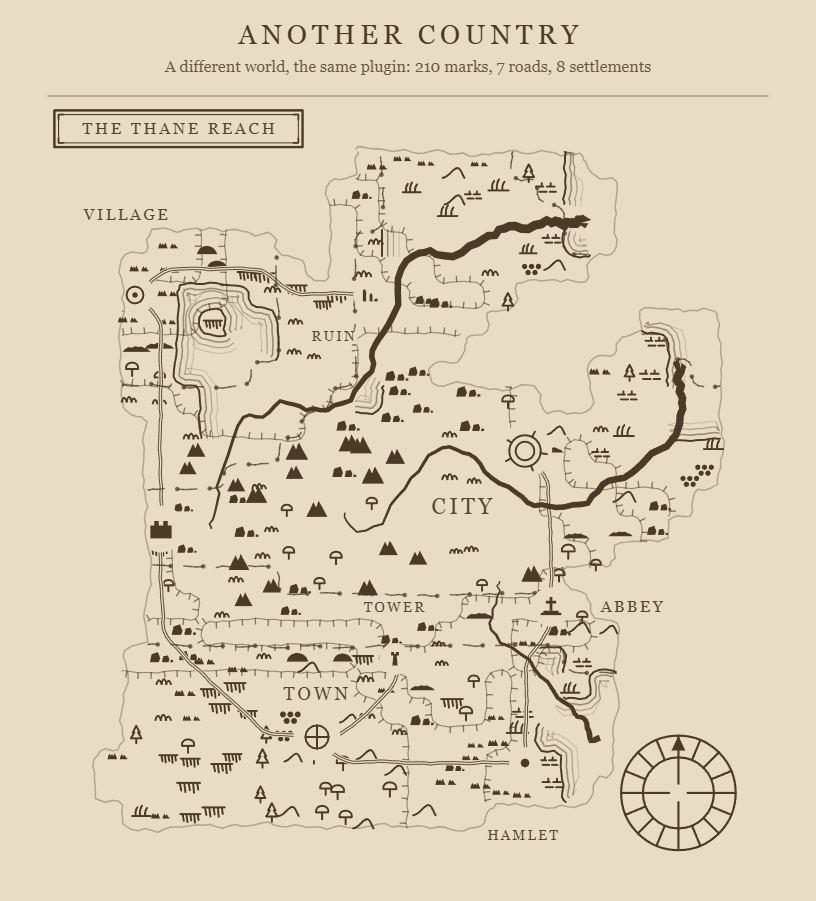
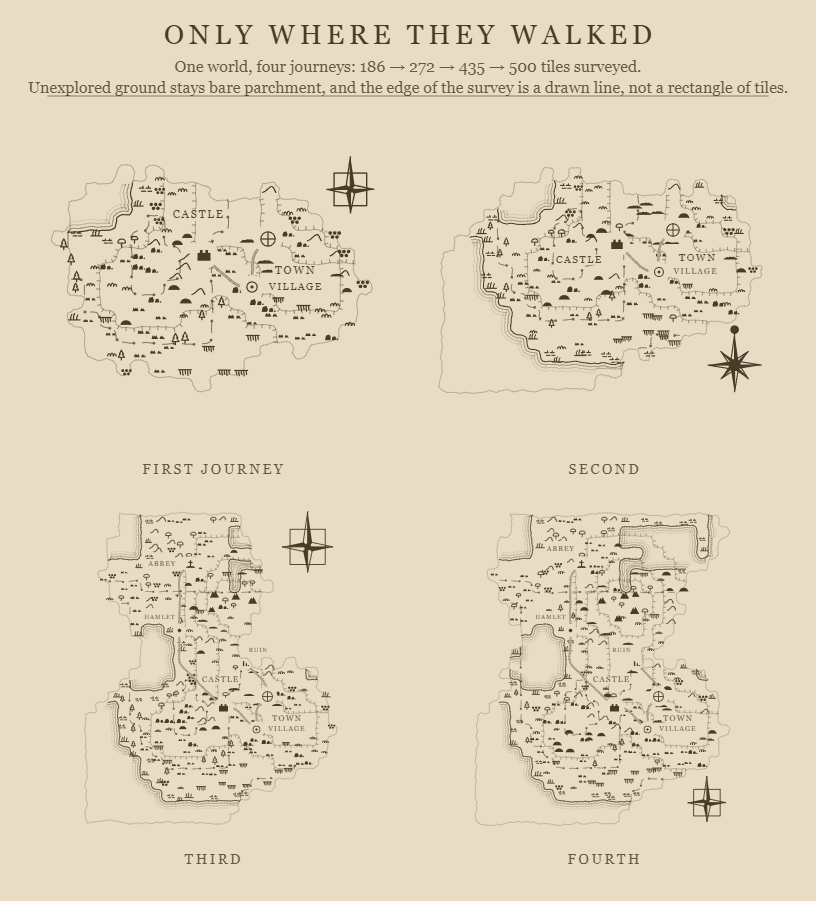
Everywhere the player has walked is redrawn as a hand-inked land survey on aged paper. Hachured relief by elevation band, woodland and marsh and scrub fills, coastline hatching, settlement stamps by size and kind, roads solved between the places they found, tapering rivers, political borders, a compass rose and a lettered cartouche — composed from the tiles they actually revealed, with unexplored ground left as unpainted parchment.
Keep your minimap. A minimap tells a player where they are. This is the artefact they earn by exploring: the thing they open at the end of a long journey, look at, and screenshot. The two do not compete.
It works on an untouched project, and that is the whole design
The obvious way to build this is to read RPG Maker's terrainTag. It is the correct signal, and it is 0 everywhere until a developer opens that dialog and fills it in — so a plugin built on it draws one terrain for every project whose author never did, which is most of them. That is not a labour-remover, it is homework.
So Chorograph classifies ground on a ladder, and every rung is a signal that already exists: (1) an explicit region mapping you set, which always wins · (2) terrain tags, but only where this project actually uses them · (3) the tile itself — which tileset sheet it came off, which autotile kind it is, how high it sits. Every project, every map, zero setup.
Measured on a project with terrainTag 0 and regionId 0 on every single tile — the common case: 195 revealed tiles produced 98 marks across 12 of the 13 terrain glyphs and all 8 settlement kinds. Drop the four files in, press play, walk around.
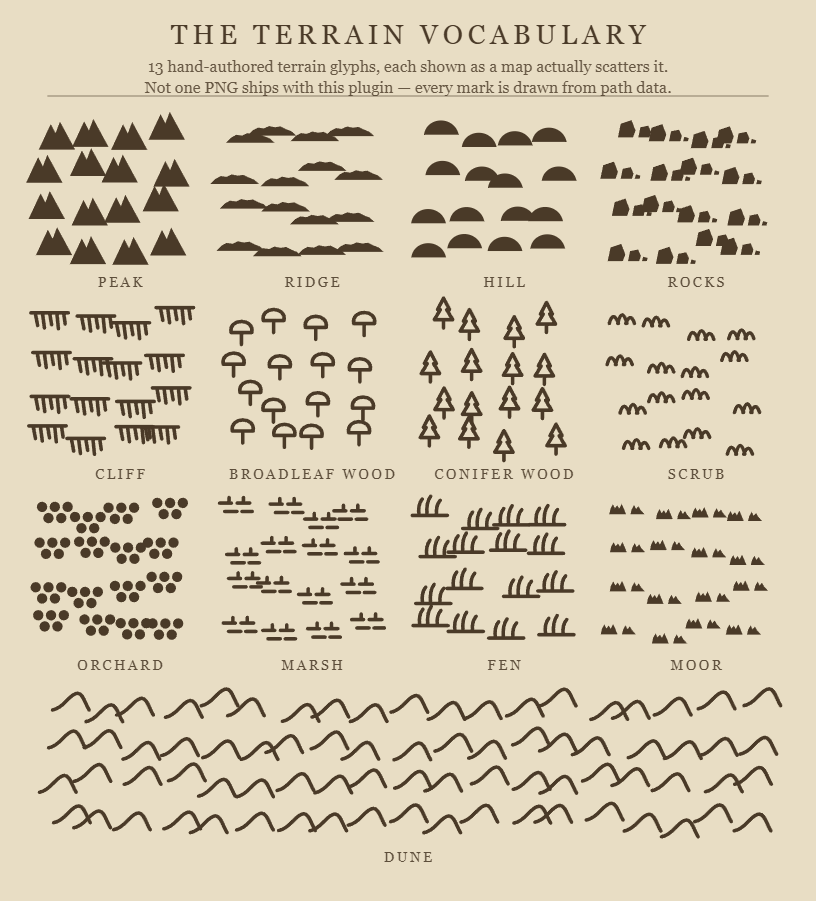
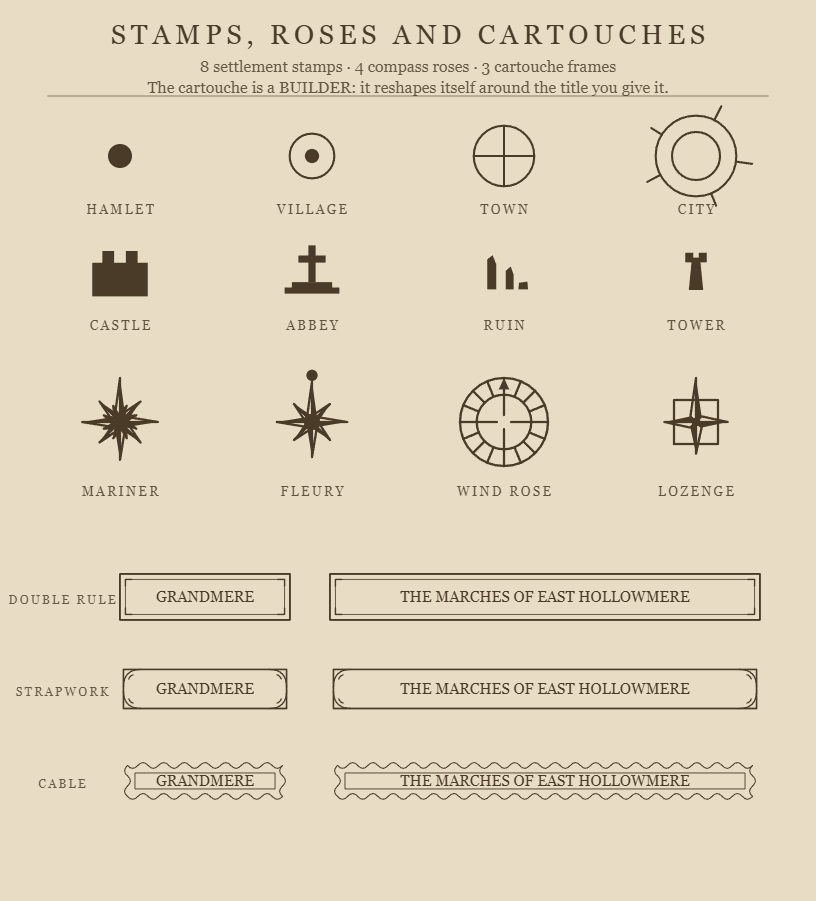
Twenty-eight hand-drawn marks, and not one PNG
- 13 terrain glyphs — peak, ridge, hill, rocks, cliff · broadleaf, conifer, scrub, orchard · marsh, fen, moor, dune
- 8 settlement stamps — hamlet, village, town, city, castle, abbey, tower, ruin
- 4 compass roses — mariner, fleury, windrose, lozenge
- 3 cartouche frames that reshape themselves around the title you give them
Every one is played from path data by the renderer at the size it is needed. The package contains four JavaScript files, a readme and a licence. There is no image in it.
And the parts no glyph table contains
The composer solves these out of the map itself:
- Elevation banding with hachures — contours following the boundary between height bands, shaded down the slope the way a survey engraves relief.
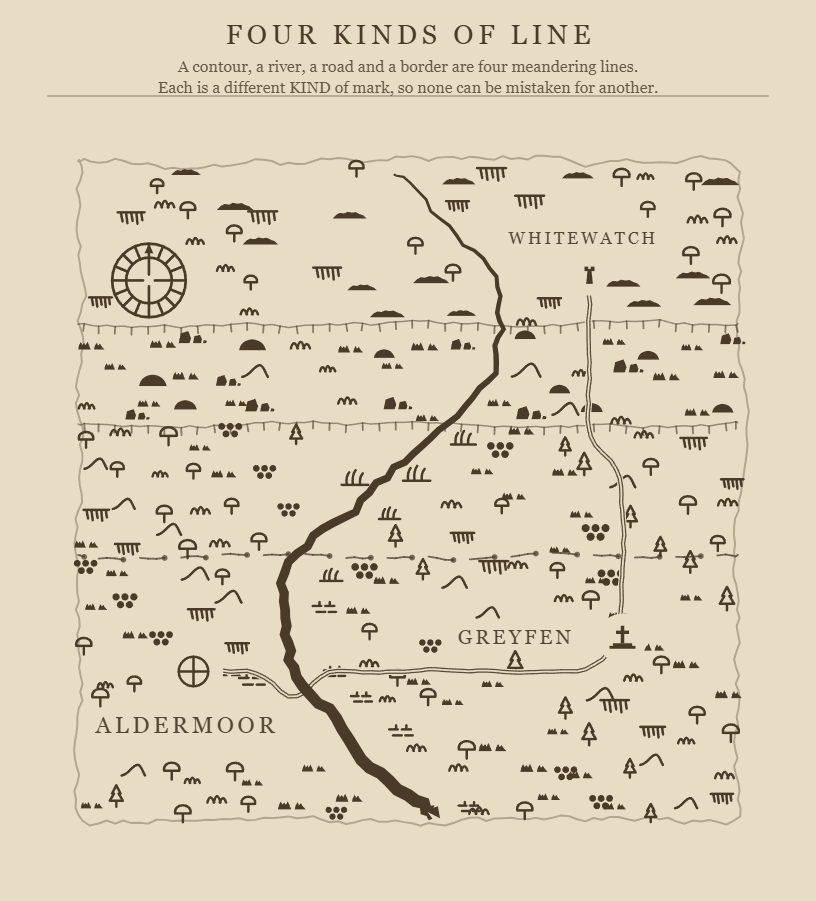
- Rivers that taper. Water is traced along its own course, filtered by length and elongation so a lake is not mistaken for a river, drawn downhill from the elevation data, and rendered as a filled tapering band rather than a stroke — wide at the mouth, fine at the source. A brook is not a river drawn small.
- Roads solved between the places the party found, not read from a tile property.
- Coastline hatching, political borders, and a toponym solver that places names without collisions and clears each label's own ground.
- The frontier — the ragged drawn edge where the survey stops and the paper is simply blank. Not a rectangle of tiles.
What you set
Survey radius · survey-while-walking on or off · the cartouche title · the ink · the paper. The whole sheet is one ink on one paper, and both are yours. Five plugin commands (open, reveal all, forget, set title, name a place) and three script calls.
Naming a place early does not leak its location — a named settlement is drawn only once the party has actually surveyed that ground.
Built the way the rest of the catalogue is built
- 310 headless checks green, run as seven separate processes and recounted independently of each suite's own summary.
- Verified in the real engine, not only in tests — including that the survey is baked once to a cached bitmap and 120 stepped frames add no display objects.
- No
Math.random()anywhere. The same explored map draws the same sheet forever, so your screenshots and recordings are reproducible. - Raw, readable, uncommented-out JavaScript. Nothing is minified. You can read every line you bought.
⚠️ Compatibility — the question you actually have
Verified against a stock RPG Maker MZ project, running in the engine.
Plugin Manager order:
ChorographRender.js— drawing primitivesChorographCorpus.js— the hand-authored marksChorographSurvey.js— the composerChorograph.js— the system, the scene and the commands
That order is a recommendation, not a requirement. Every file resolves its siblings the first time it needs them rather than when it loads, so the plugin works in any Plugin Manager order — including the one you get by dragging the files in backwards.
Core methods extended — all 3 by saved-original prototype extension, none replaced: Game_System.prototype.initialize, Game_Player.prototype.increaseSteps, Scene_Map.prototype.onMapLoaded. It adds one new method, Game_System.prototype.chorograph. The other three files touch no core prototype at all.
Three extensions and zero replacements is the whole footprint, which is why a conflict is unlikely — and anything else that patches those three still runs, because Chorograph saved the original and calls it. Save-safe and versioned in both directions: a save made before you added the plugin loads, and so does one made by a newer version.
More from Core Systems Asset Factory
If you want the sea rather than the land, Voyage Core makes ship travel a system you play on a chart instead of a fade to black. Vista draws every battle its own arena, Augury generates a 78-card oracle deck that reads the playthrough, and Epistolary turns every letter into a drawn object. The full catalogue is here.
Made with AI assistance: code yes, graphics yes, sounds no, text and dialog no.
Purchase
In order to download this asset pack you must purchase it at or above the minimum price of $14.99 USD. You will get access to the following files:
Development log
Leave a comment
Log in with itch.io to leave a comment.