TIDEPOST
You carry the mail between 9 islands, and the ocean itself is the mechanic. Free, in your browser, no account and no install.
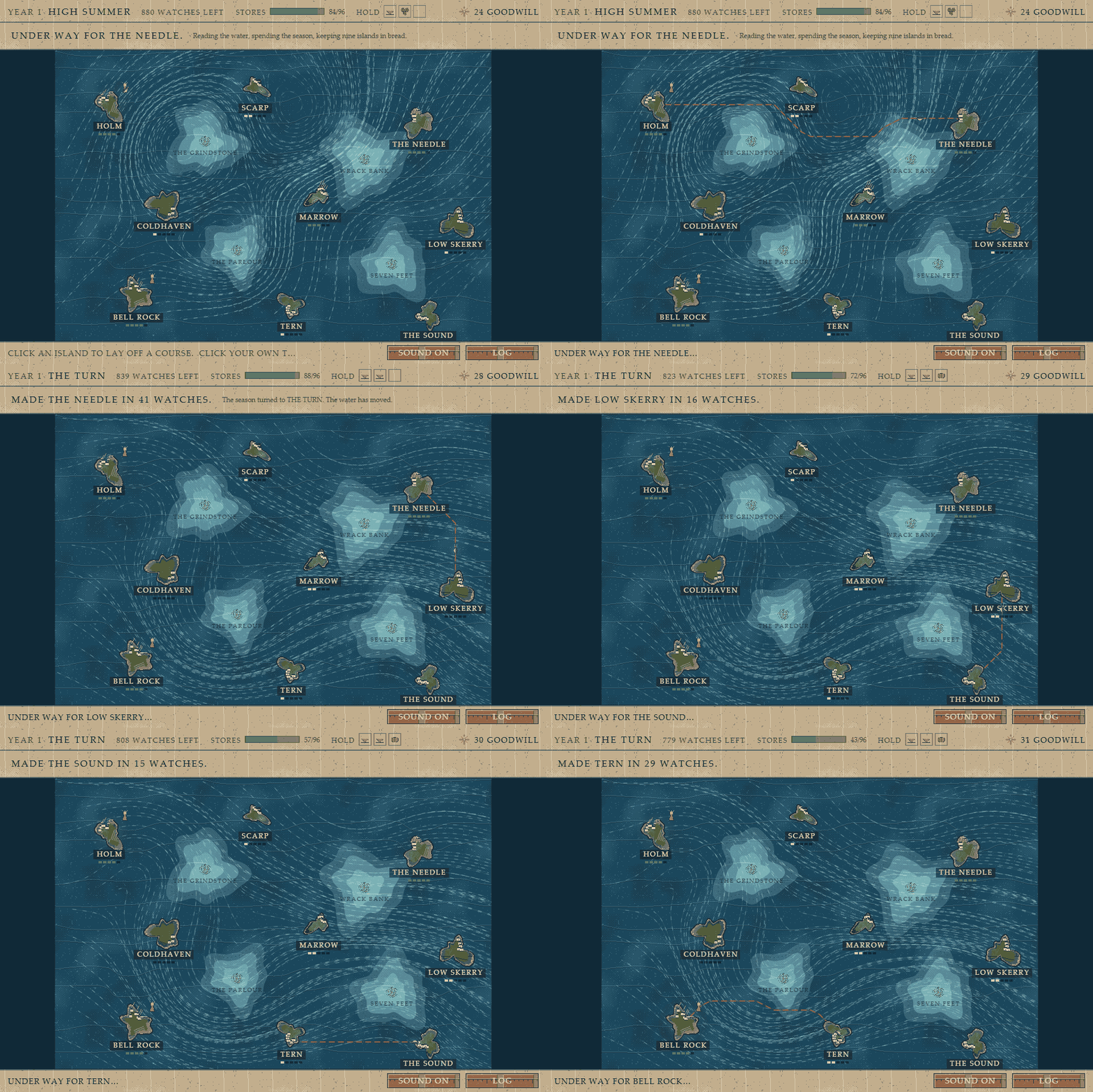
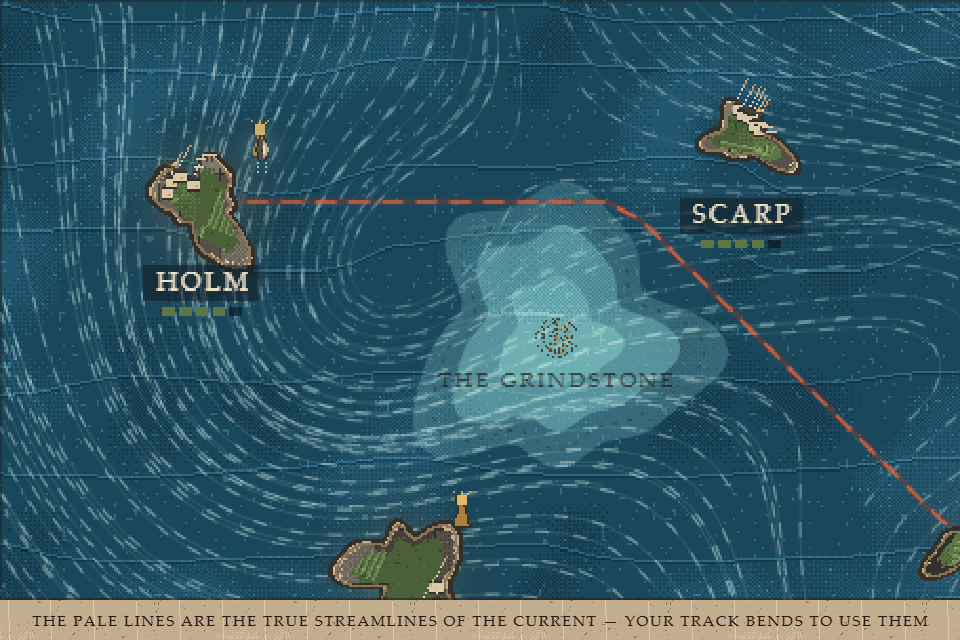
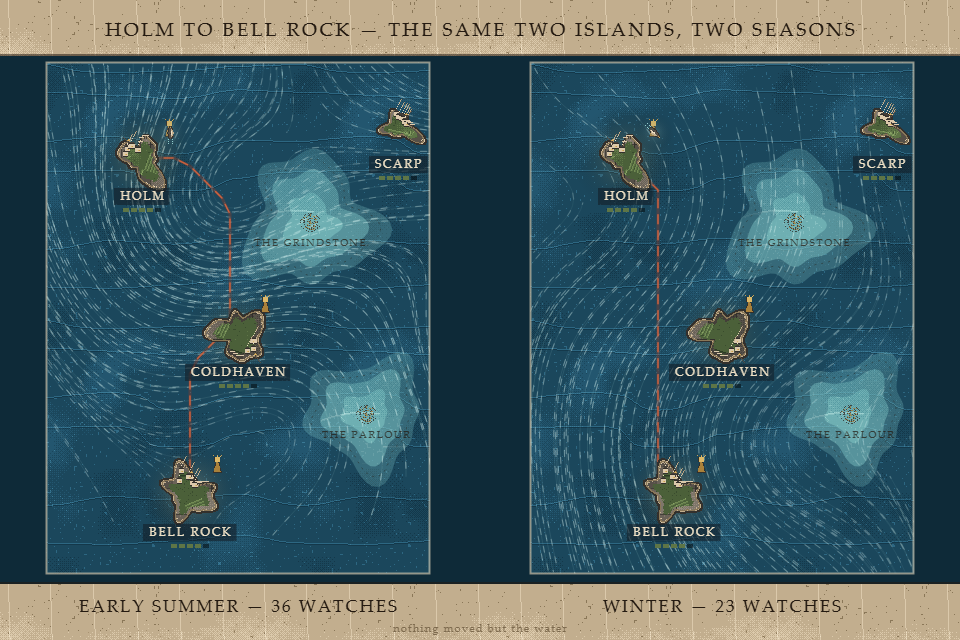
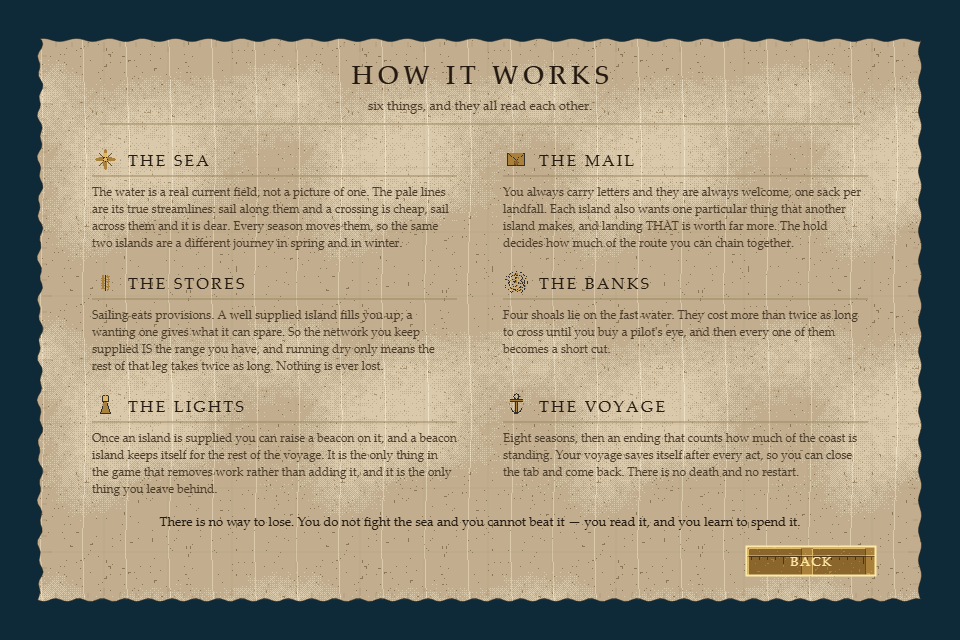
The sea in TIDEPOST is a real current field. The pale lines drawn across the chart are its true streamlines — not an artist's impression of moving water, but the actual level sets of the function the game is solving. Sail along them and a crossing is cheap. Sail across them and it is dear. And the whole field moves with the season, so what is a fair passage in early summer is dead to windward by winter.
You do not fight it and you cannot beat it. You learn to read it, and you learn to spend it.
Four systems, and every one of them reads the other three
- The current decides what a crossing costs. Lay off a course and watch the track bend to use the water.
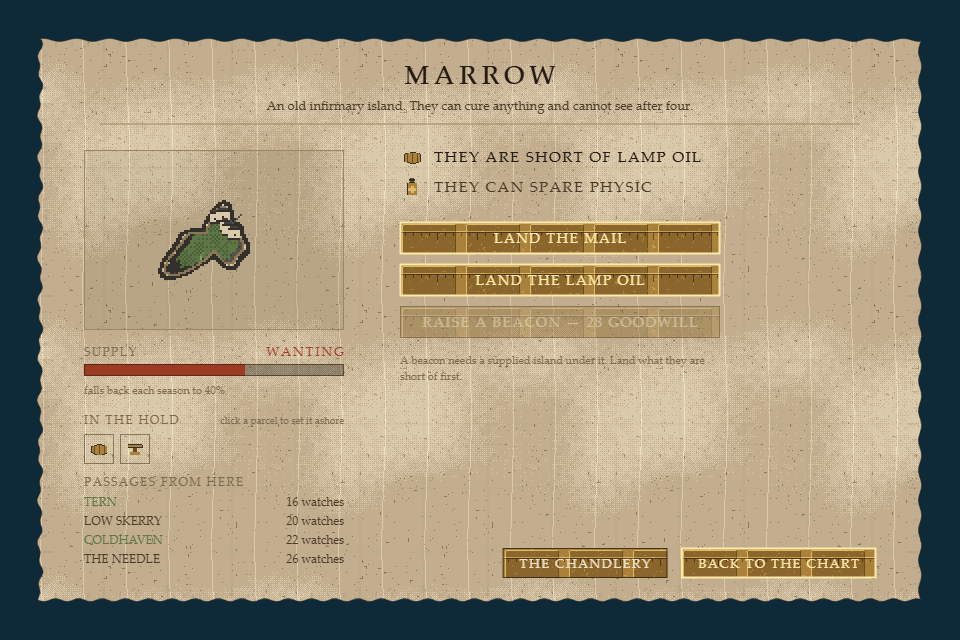
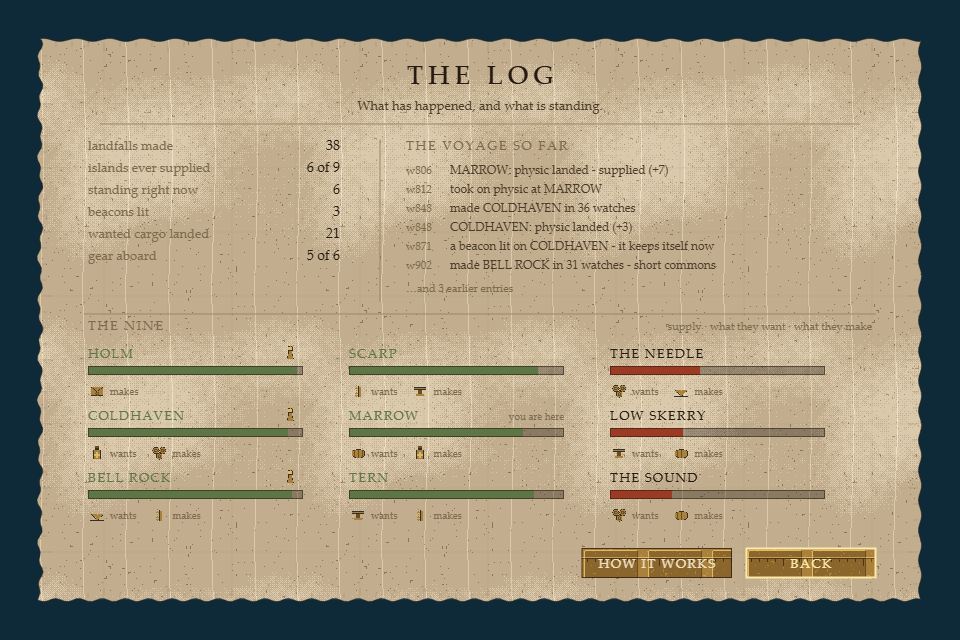
- The stores decide how far you can go. Sailing eats provisions; a well supplied island fills you up and a wanting one gives what it can spare — so the network you keep supplied is the range you have.
- The cargo decides the order. You always carry letters and they are always welcome, but each island is short of one particular thing that another island makes. 6 goods, and the route is the puzzle.
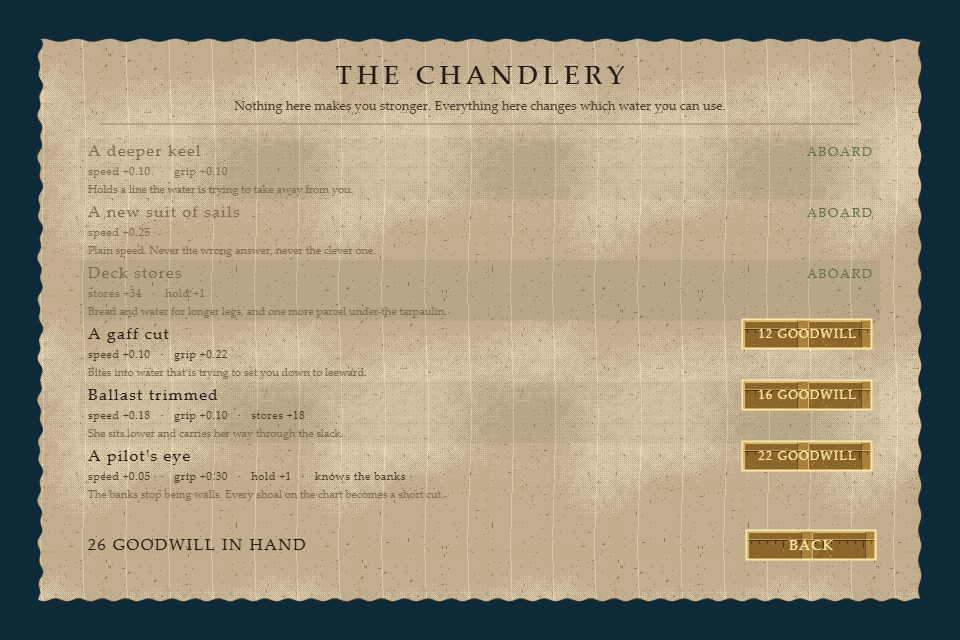
- The gear changes which water you can use. 6 pieces, and not one of them makes you stronger — a deeper keel refuses a current that is setting you down to leeward, and a pilot's eye turns 4 dangerous banks into 4 short cuts.
There is no way to lose
No death. No failure state. No cargo that can be destroyed and no restart. An island's supply falls back between seasons but never below a floor it has already earned, so an island you once made whole is permanently better off than one you never reached. Run out of provisions and the rest of that leg simply takes twice as long.
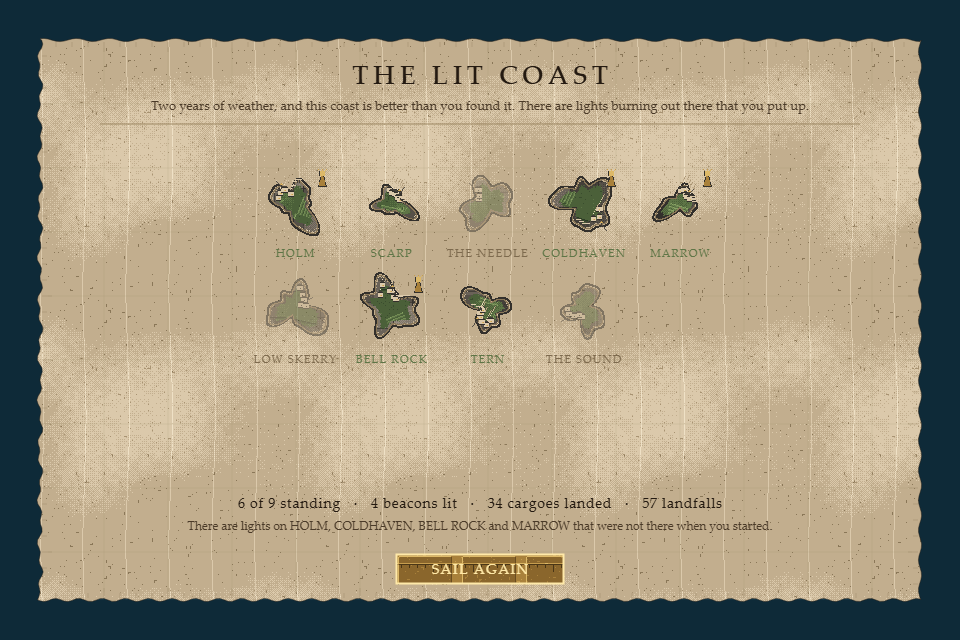
Once an island is supplied you can raise a beacon on it, and a beacon island keeps itself for the rest of the voyage. It is the only thing in the game that removes work rather than adding it, and it is the only thing you leave behind.
8 seasons — two years of 4 — and then an ending that counts how much of the coast is standing. Every ending is a real one. The worst honest outcome is a coast where a few islands were kept, and that is still a coast that was kept.
Controls
Mouse: click an island to lay off a course, click again or press SAIL to go, click your own island to go ashore. Keyboard: arrows or Tab to pick a destination, Enter to sail, L for the log, H for how it works, M for sound, Esc to go back — the whole game is playable from the keyboard. Touch: a tap is a click, and it runs on a phone.
Your voyage saves itself after every action. Close the tab and come back whenever you like.
Everything you can see, the game made
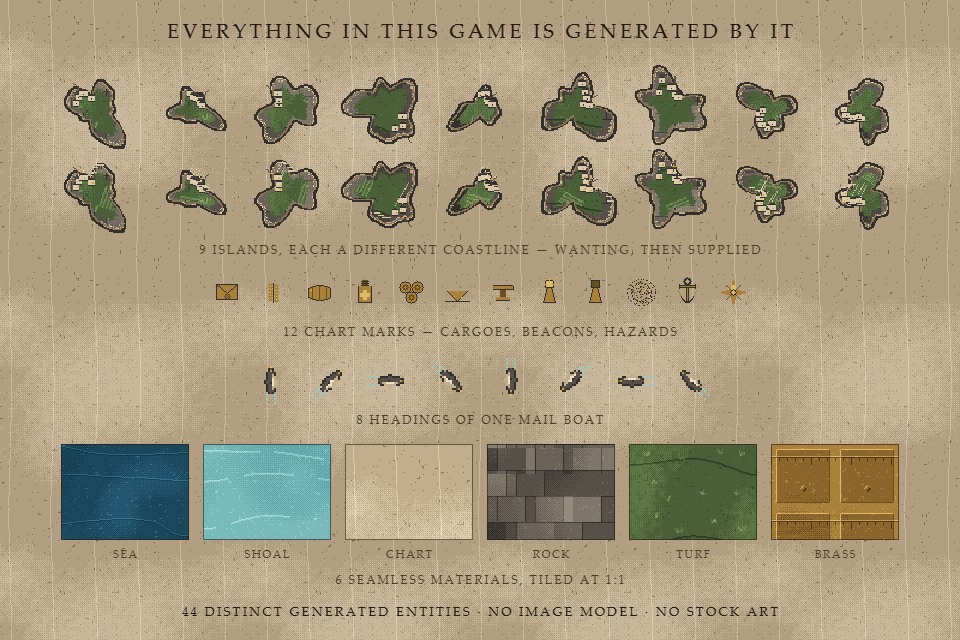
44 distinct generated entities, and none of them is stock art: 6 seamless material plates, 9 island coastlines drawn in two states each (wanting, and supplied — lit windows, smoke, cut fields and a lantern on the quay), 12 chart marks and 8 headings of one mail boat. The land inside every coastline is sampled from those same material plates, so the islands are made of the same stuff as the rest of the world. The 9 audio files are rendered from authored scores as arithmetic — no sample library, no model.
Hand-written HTML5. No engine, no framework, no build step, no minification — the whole thing is readable in your browser's own view-source.
Honest notes
- The archipelago is fixed, not procedural. 9 hand-placed islands with hand-written wants and produce. What changes between voyages is the water, the season you meet it in and the order you choose — not the map.
- A voyage runs about 20 to 30 minutes. It is meant to be finished in one sitting, and it saves if it is not.
- Nobody has heard this on speakers. Every audio file is measured rather than listened to — levels, loop seam, silence, clipping. If something sounds wrong to you, say so and it will be fixed.
AI disclosure: code yes, graphics yes, sounds no (procedural synthesis of an authored score is arithmetic, not a generative model), text yes. The store cover is a generated painting; nothing from it appears inside the game. Full provenance ships in CREDITS.txt.
More free browser games from CSAF
- BANNERET: SUCCESSION — Plant the banner and the whole House charges it. The dead stay dead — their heirs inherit the blood, flaws and all.
- CHARGE BARGE — Drive a storm ironclad up a hostile coast. Volts buy the hull; surge buys the miracle; the ram is a decision.
- OTTERBOUND — Six otters, one raft, and a river that never ends the same way twice.
- THE LAST FLOCK — Your army is a crowd you shape with movement alone — and it dies.
- RUSTBLOOM — You never find the key. You forge it. A top-down adventure where every lock has many answers.
- SECOND INTENT — A duel where the opponent is openly building a read on you — and shows you exactly what it has learned.
- FLOODMARK — The flood is not the disaster. The flood is the harvest. A cozy town builder you play by aiming a river.
- ANNEAL — Pour it big. Pour it right. You rarely get both. A free foundry game about size and temper.
- PERIGEE — An indirect god game where your only lever is the moon. Set the orbit; the tide does everything else.
- PRISMHORN — Seven bands leave your horn at once. Each one is a verb, and they fire together — you aim all seven or none.
- STARCHART — Every voyage you fly is inscribed forever — the route you took becomes the constellation.
- HALFLIGHT — Everything in the vault is decaying. That is what pays you.
- WHAT WE BURN — A horror game about the cost of staying warm. Burn what made you a person, or freeze holding on to it.
- UNDERSTORY — Spread a fungal network through a forest floor. Digest what you reach. It never wipes your board.
- SWALLET — You are the hole in the hill. Cut chambers, set wards, and decide who gets back out. Free, and it never resets.
- FROSTLEDGER — The ground gives more every winter. You pay for it out of the things you can still be moved by.
- BITTERWORKS — A soda works on a drying salt lake. The brine is finite, it moves, and the works has to follow it.
- CARILLON — A tower defence whose towers never shoot. Hang bells; where two rings touch, a spark is born.
- OUT OF SORTS — A typing roguelite in a letterpress shop. You do not have a word list, you have a type case.
- THE WARM ROOM — Keep a derelict glasshouse alive through one winter. The heat in the room is made of the people in it.
- MAKE YOUR NUMBER — Six ships in the dark and one lamp. Every case is generated, then proven to have exactly one answer.
Development log