Liturgy — Every Menu Becomes A Printed Object, for RPG Maker MZ
A downloadable asset pack
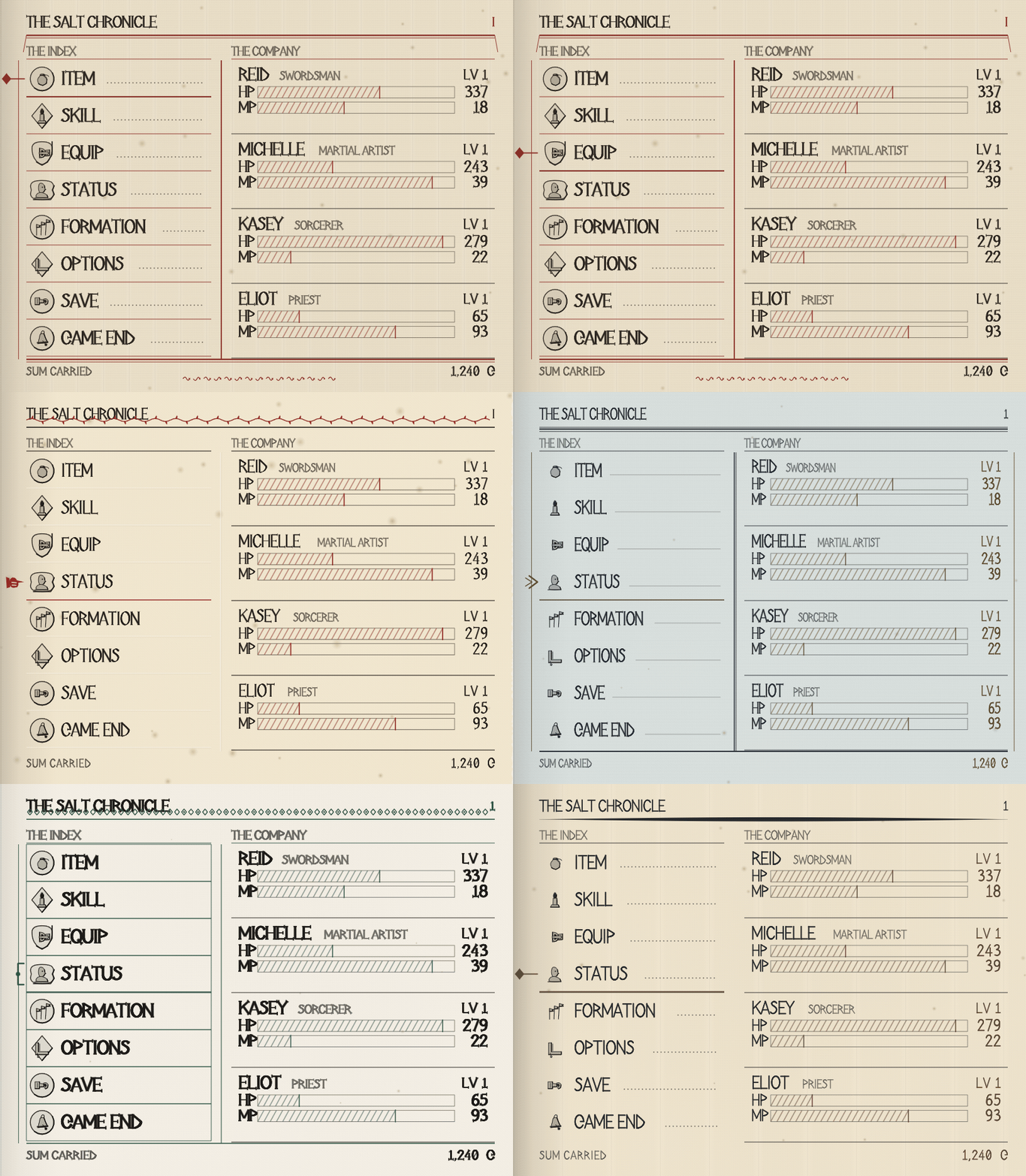
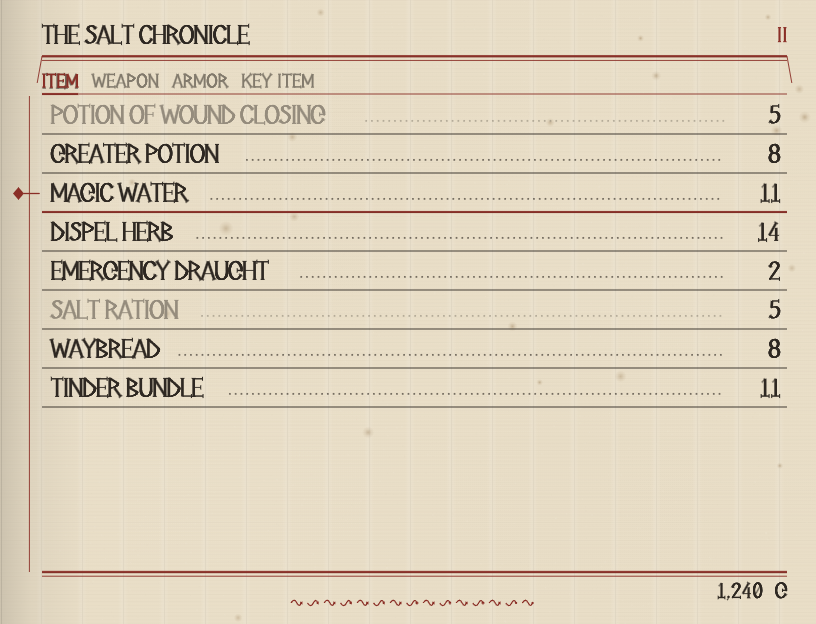
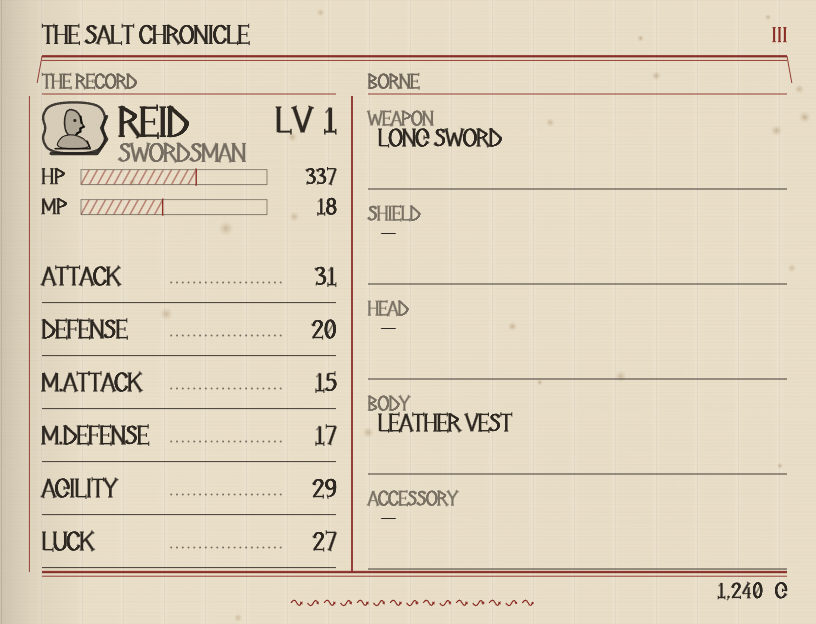
Your menu is the one screen a player opens every session, and in most RPG Maker games it is four blue boxes. Liturgy redraws the main menu, the item list and the status page as one printed object: a ruled ledger page with real paper, an engraved rule system, a drawn alphabet, and a device beside every command composed from what that command does.
It does not change your menu. Your command list, the commands your other plugins add, your handlers, your selection and your input all stay exactly where they are. Liturgy prints them.
Not a windowskin, and not a layout builder
Every menu tool on this shelf asks you to do the work: lay the windows out yourself, or supply your own PNGs. Liturgy generates the page from what is already in your project. There are no image files in it at all â every mark on screen is drawn at run time.
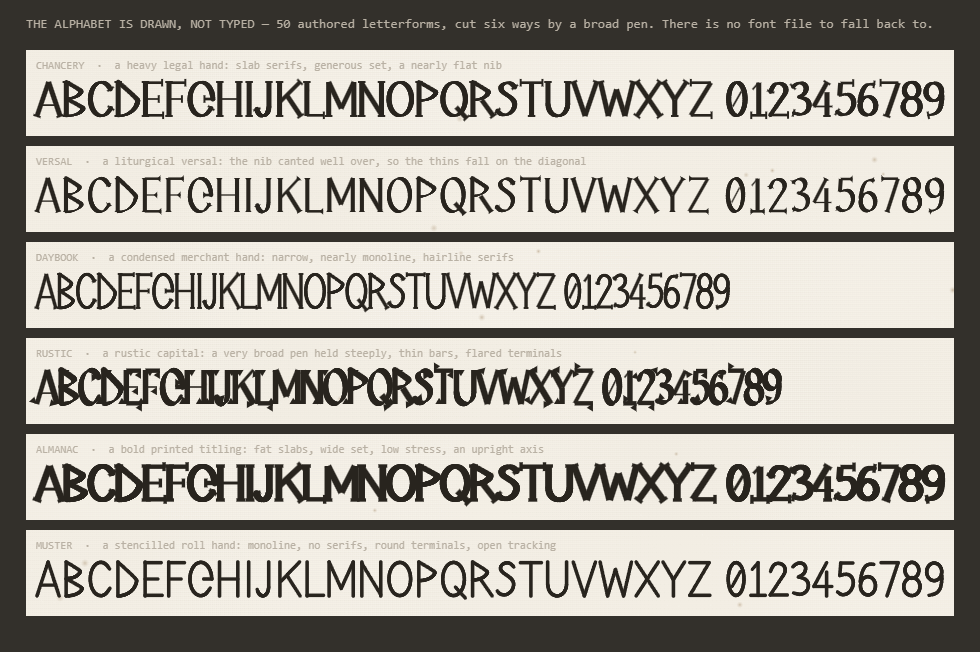
- 49 authored letterforms, cut 6 ways by a broad pen. Stem weight, pen angle, serif treatment, set width and tracking are all axes, so the six houses have six genuinely different alphabets rather than one alphabet in six weights. No font file, which means nothing on the page can fall back to RPG Maker's own typeface.
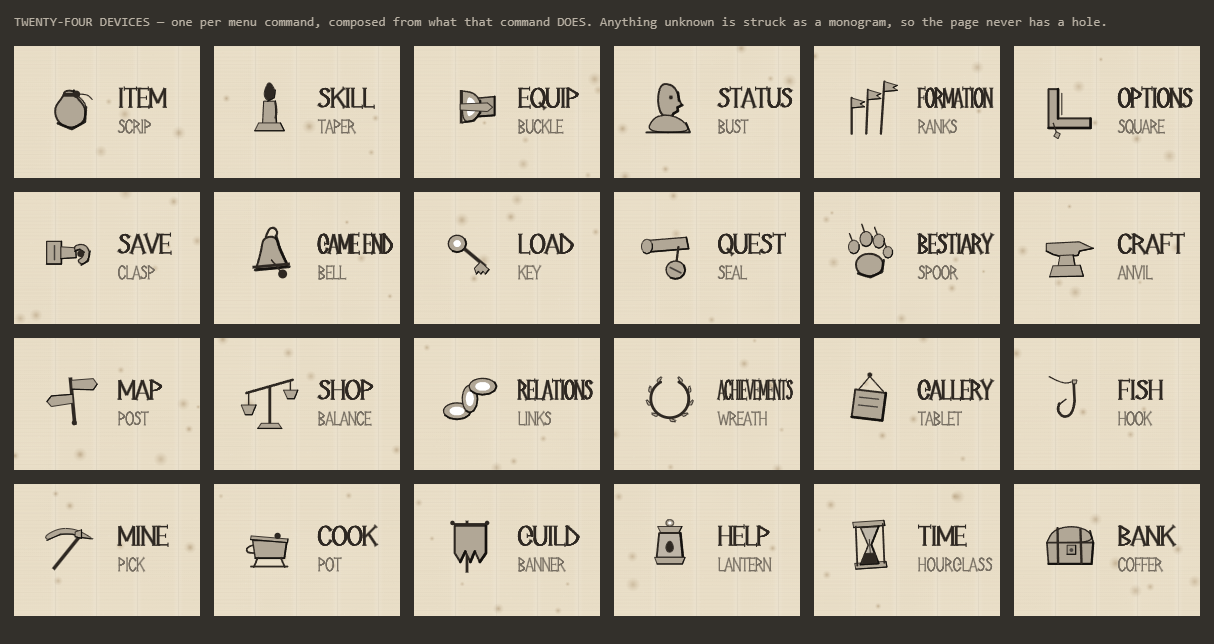
- 24 devices, one per menu command. Chosen from the command's symbol first, so the stock eight are right in a project of any language whatever the menu says. 42 symbols and 159 words are recognised, covering quests, bestiaries, crafting, maps, shops, relations, achievements, galleries, fishing, mining, cooking, guilds, help, calendars and banking â and anything unrecognised is struck as a monogram of its own initial, in the same alphabet, so the page can never render a hole.
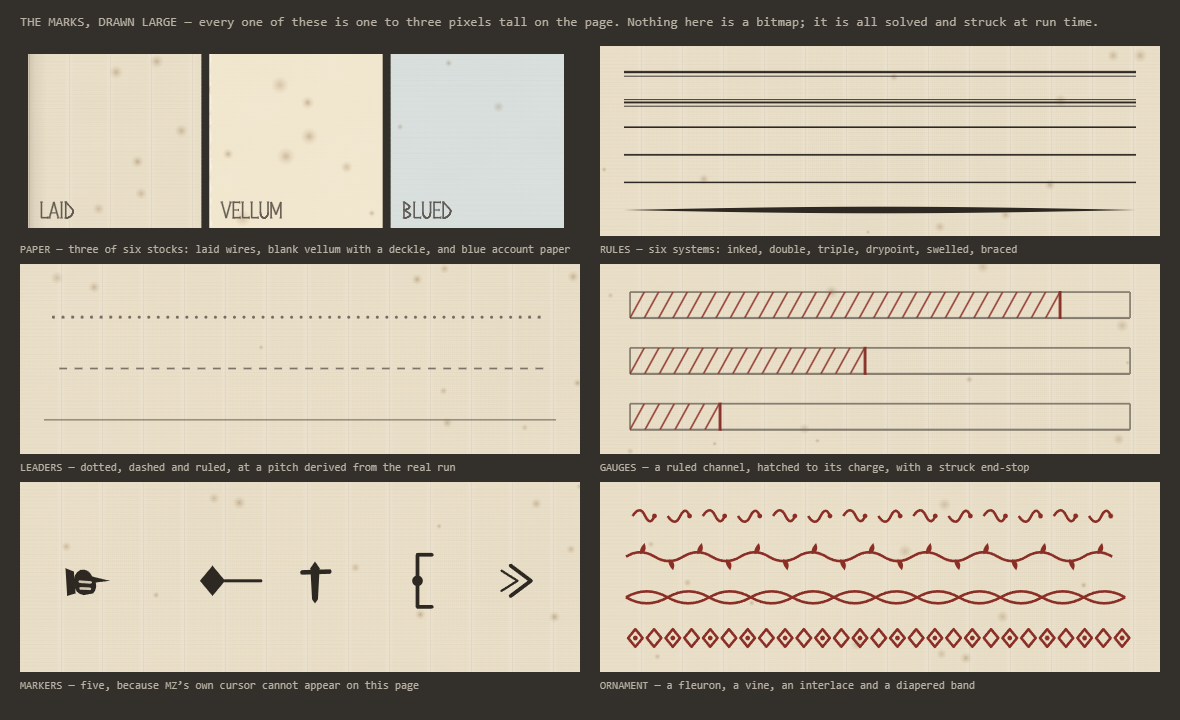
- 6 papers and 6 rule systems. Laid and chain wires, tooth, foxing, a deckle edge and the fold at the gutter â every count derived from the real run, so a bigger page has more wires rather than bigger ones. Rules that are inked, doubled, tripled, scored into the sheet as drypoint, swelled toward the middle, or braced at the corners.
- 5 markers, because MZ's own cursor cannot appear on this page. The chosen entry is marked the way a reader marks a book: a pointing hand, a lozenge with a tail, a dagger, a bracket, a chevron.
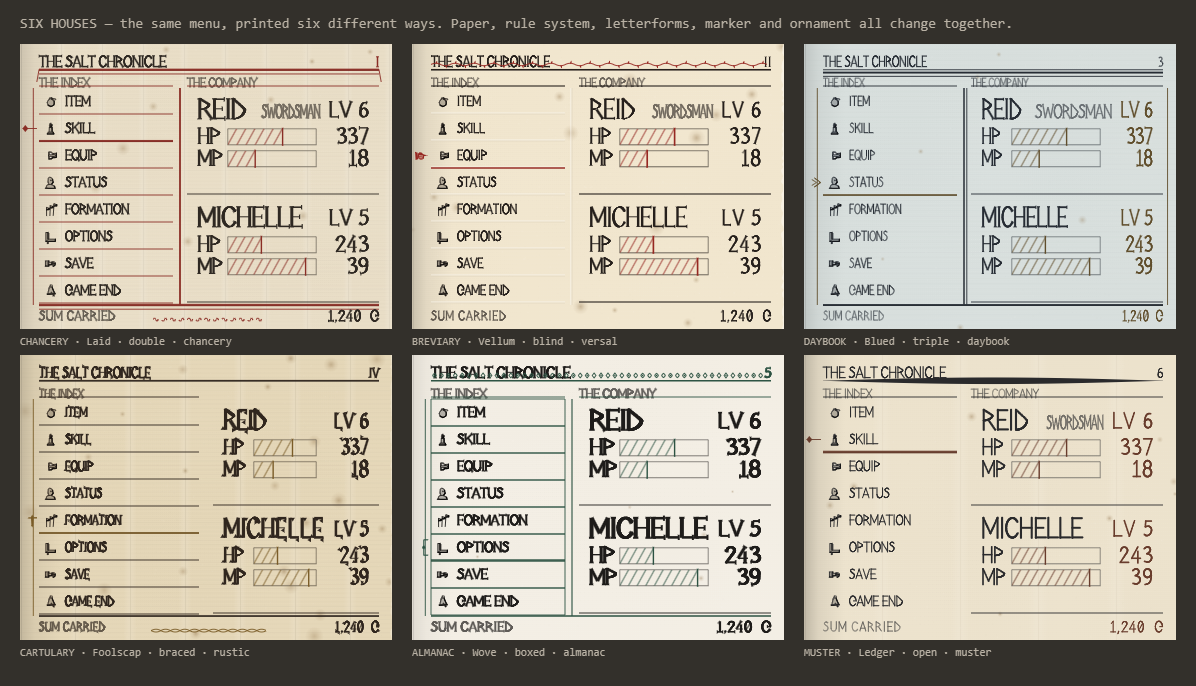
The six houses
A house is a decision about a kind of book, not a colour scheme â the paper, the rules, the letterforms, the marker and the ornament all change together.
- Chancery â a legal register: laid paper, double rules at head and foot, dotted leaders, the rule turning a corner and returning down a red margin.
- Breviary â vellum with a deckle edge, rules scored rather than inked, a liturgical versal with the nib canted over, a manicule in the margin.
- Daybook â blue account paper, three rules at the head, a condensed merchant hand, the figures in a second ink.
- Cartulary â coarse foolscap, braced corners, rustic capitals, an interlace tailpiece.
- Almanac â smooth wove, every entry in its own ruled box, a bold printed titling and a diapered band across the head.
- Muster â heavy ledger stock, one swelled rule at the head and nothing else ruled anywhere, a stencilled monoline roll hand.
Set the house yourself, or let it read your project's title. A plugin command changes it mid-game, so chapter two can be a different book from chapter one â and it is saved with the game.
It fits whatever menu you have
Eight commands get a generous page. Sixteen get a tighter one: the row height is solved from your real command count, and the treatments that stop resolving at that size â the leader, the device's ground, the sub-line â drop out in order rather than being crushed. That is arithmetic, not a setting.
Tested, not assumed
- Verified in the real MZ runtime, not only in tests: 23 checks including a proof that every window's contents bitmap is entirely transparent â the only route by which the engine's own font could reach the screen.
- The shipped zip was unpacked into a pristine blank project and used with every parameter blank, because that is what a buyer does first.
- A mouse click lands on the entry you can see: the printed rows and the window's own hit-test rows are asserted to agree, row by row.
- Nine adversarial cases â twenty commands, an empty party, a 68-character command name, a Japanese command name with no symbol, a corrupt save from a future version, a 320x240 frame.
- Per frame in the engine: 11 draw calls, 0 texture uploads, 0 bitmap dirties, 0 window refreshes, and display-object growth of 0. The page is drawn once and redrawn only when something on it changes.
â ï¸ Compatibility â the question you actually have
Tested against RPG Maker MZ with the stock scripts unmodified, verified by running the plugin in the real engine rather than only in tests.
Plugin Manager order:
LiturgyInk.jsâ [Liturgy] The colour and scale LAWS, and the single light. Every ink is solved against what it sits on; every repeated treatment declares a pitch.LiturgyAlphabet.jsâ [Liturgy] The DRAWN alphabet. 44 authored letterforms and a parametric fount, so every heading, command and name on the page is drawn rather thanâ¦LiturgyCorpus.jsâ [Liturgy] The authored corpus - six houses, six stocks, six rule systems, five markers and the charges every menu command is composed from.LiturgyPaper.jsâ [Liturgy] The paper. Laid and chain wires, tooth, foxing, deckle and the gutter, every count derived from the real run. No engine dependency.LiturgyRule.jsâ [Liturgy] The engraved rule system - rules, leaders, corners, ornament bands, markers, printed gauges and folios. Every count derived from the run.LiturgyDevice.jsâ [Liturgy] The device struck beside every menu command, composed from what that command DOES - 24 authored charges, five bearers, and a struck monogramâ¦LiturgyReading.jsâ [Liturgy] The classifier. Reads the buyer's own project and their own command list, and returns the page spec everything else draws from.LiturgyPage.jsâ [Liturgy] The assembler - one whole ledger page into a rect, and the ONE geometry declaration every other file reads. Engine-free by design.LiturgyScene.jsâ [Liturgy] Every menu becomes a printed object. Draws the main menu, the item list and the status page as one ruled ledger page, generated from yourâ¦
Core methods extended â 7 by saved-original prototype extension: Scene_Menu.prototype.create, Scene_Menu.prototype.start, Scene_Item.prototype.create, Scene_Status.prototype.create, Scene_Status.prototype.start, Scene_Status.prototype.refreshActor, Scene_Boot.prototype.start.
Those seven are shared politely: another plugin patching the same ones keeps working, whichever order they load in. The replacements are listed next, because they are the part that can conflict.
Core methods REPLACED â 3 on Scene_Menu: Scene_Menu.prototype.commandWindowRect, Scene_Menu.prototype.statusWindowRect, Scene_Menu.prototype.goldWindowRect.
That is deliberate and it is what you are buying â but be plain about what it means: Liturgy will not co-exist with another plugin that also replaces Scene_Menu, and whichever loads last wins. The originals ARE saved, so the stock behaviour can be put back at any time. Everything else in your project is untouched.
Also from Core Systems Asset Factory
The screens either side of this one, drawn the same way: Frontispiece generates the title screen · Cartouche draws the message box as a worked object · Escutcheon strikes the equip and status plate.
AI disclosure: the code and the cover artwork in this product were produced with AI assistance. RPG Maker MZ. Nine plugin files, raw and readable â no minification, nothing to unpack.
Purchase
In order to download this asset pack you must purchase it at or above the minimum price of $14.99 USD. You will get access to the following files:
Development log