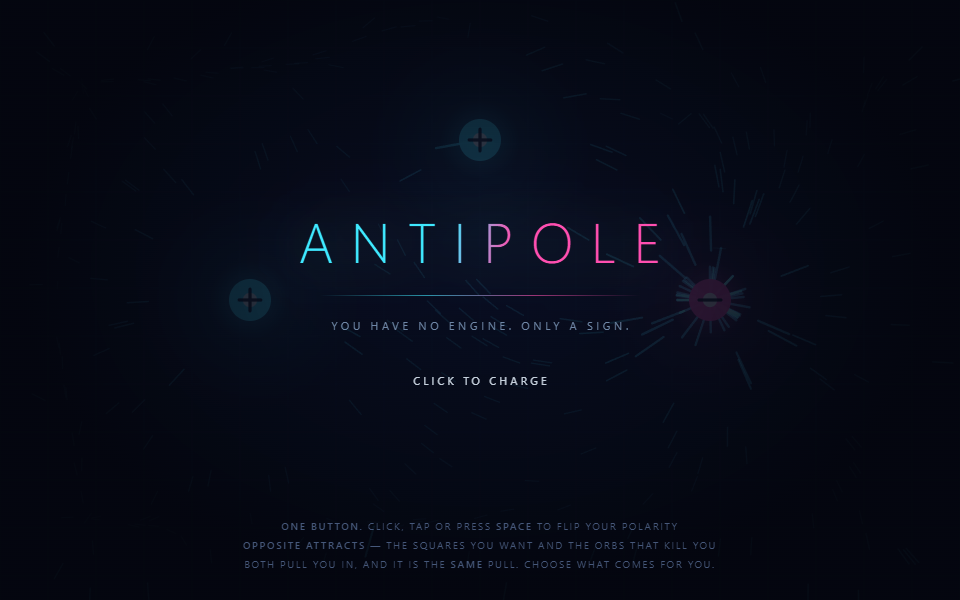
ANTIPOLE
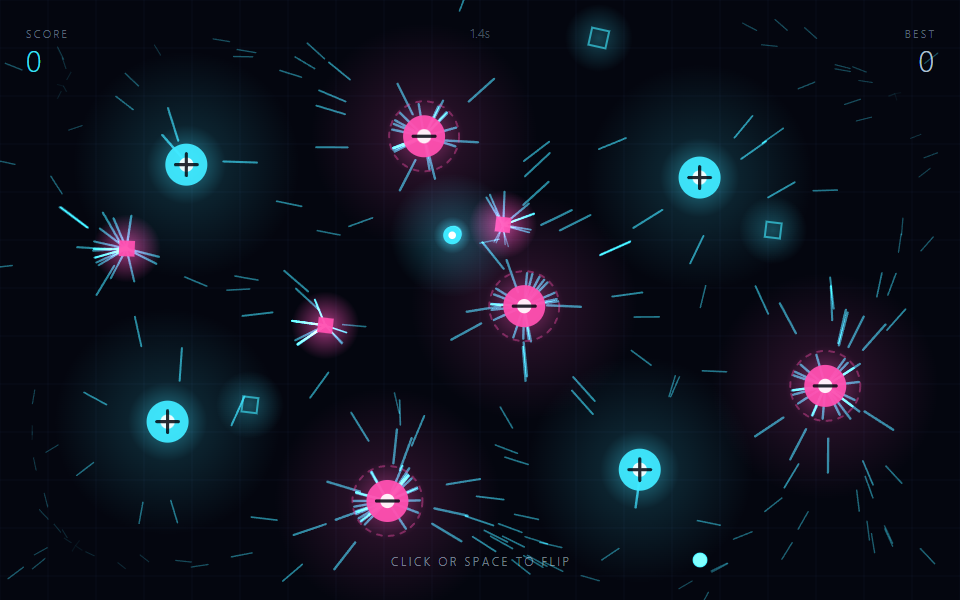
You are a charged particle. You cannot steer, you cannot thrust, and you cannot stop.
The only thing you control is whether you are positive or negative.
One rule
Opposite attracts.
That is the entire game, and everything follows from it:
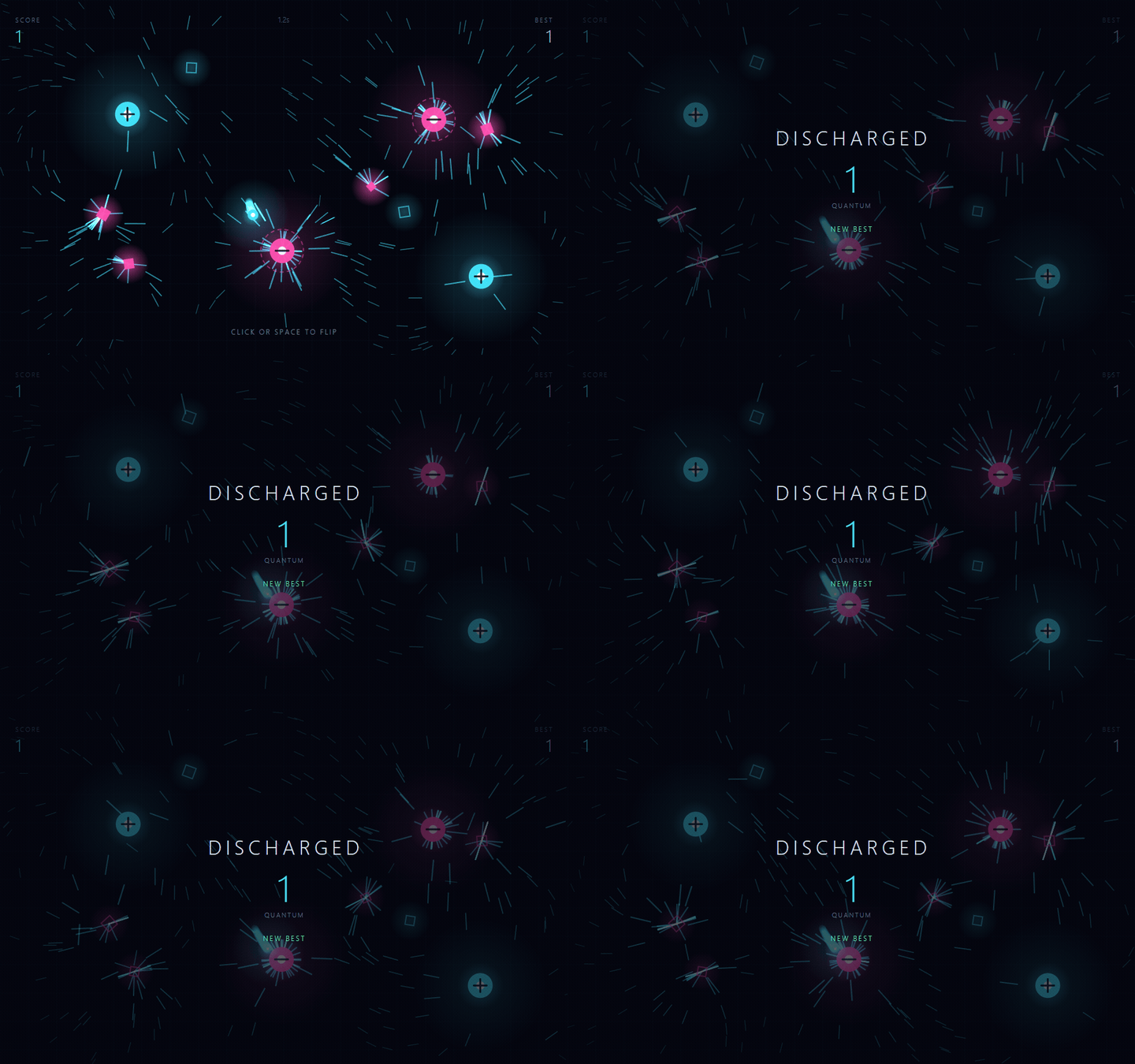
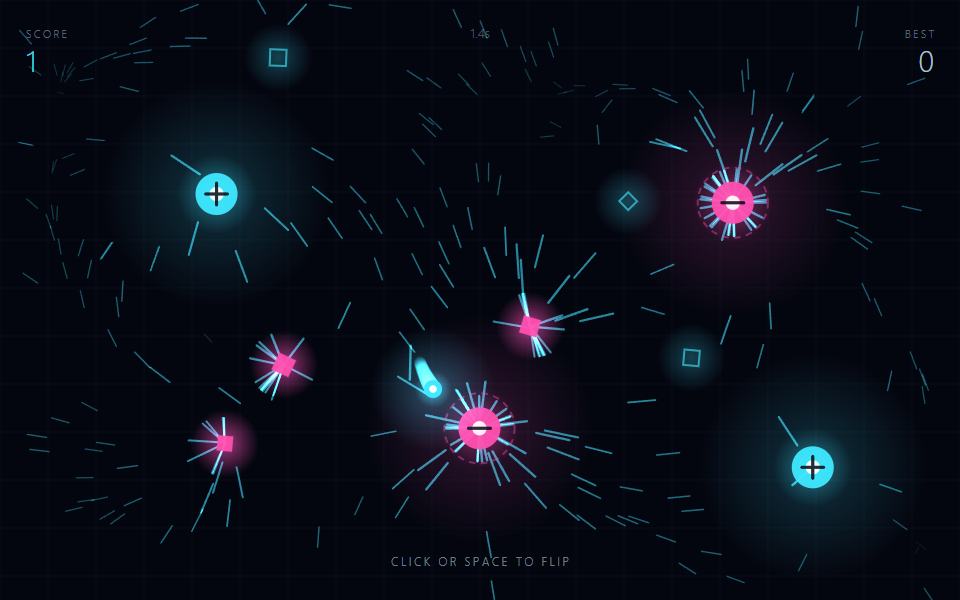
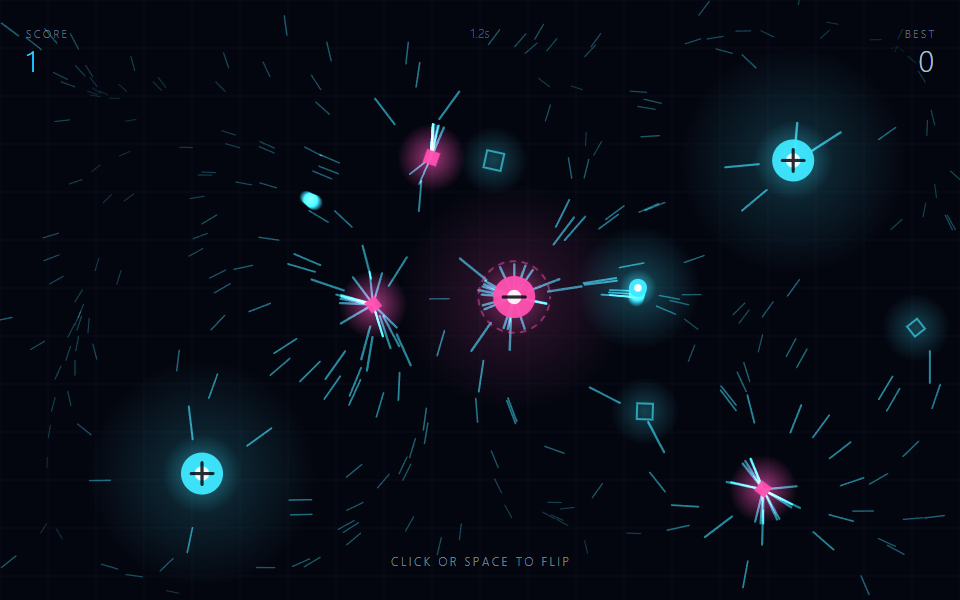
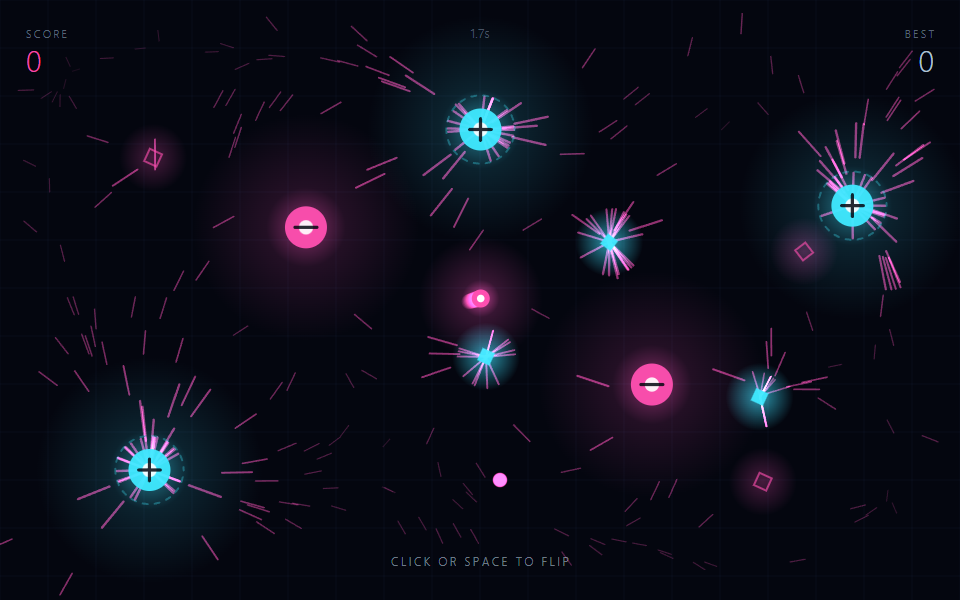
- Orbs of the opposite sign pull you in — and kill you on contact.
- Orbs matching your sign shove you away, and can never touch you.
- Squares of the opposite sign drift toward you and can be collected.
- Squares matching your sign flee.
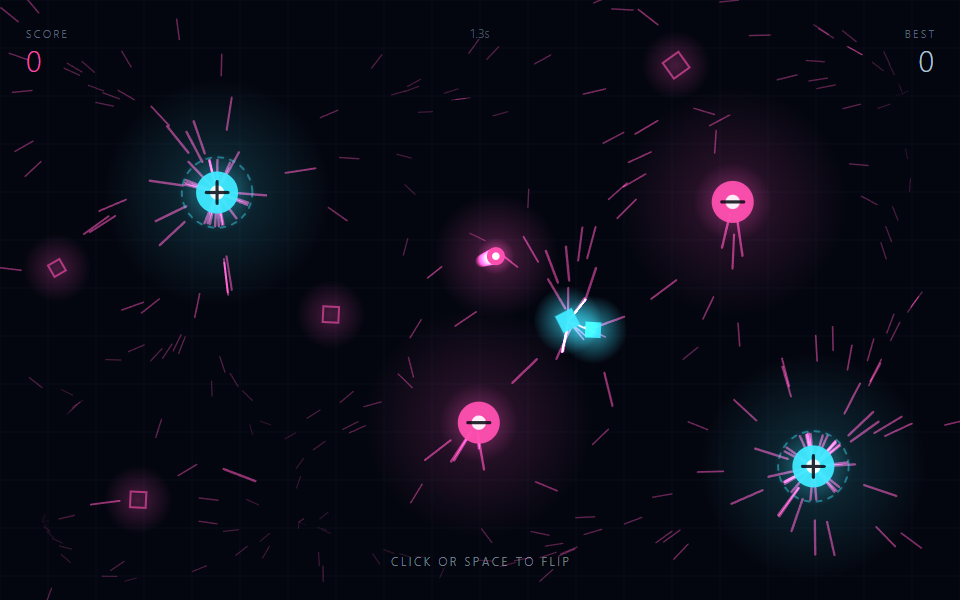
So the thing you want and the thing that kills you are the same pull. Flipping does not merely change what you may touch — it changes what is coming for you. The button that saves your life is the button that ends it.
The field you see is the field that moves you
Every streak on screen is the real solver, sampled at that point, with your current polarity — the same call, in the same frame, that accelerates you and decides which orbs are lethal. When you flip, the whole room reverses because the physics reversed, not because something was animated to look like it did. Where the streaks crowd and glow is where the force is fiercest.
Learn it in four seconds
A player who never touches the button dies in about four seconds. That is the tutorial.
The orbs close in as the run goes on, and stop keeping their distance entirely at around forty-five seconds. Long runs end. That is intended.
Controls
- Click / tap / SPACE — flip polarity
- M — mute
- Click or Space to restart
Under the hood
21 KB, no install, no account, no network requests after load — and no third-party code of any kind. No engine, no framework, no library, no font file, no image file, no audio file. Every pixel is drawn to a canvas at runtime and every sound is synthesised from oscillators and filtered noise by the Web Audio API.
The balance was not guessed at. It was measured with instrumented autoplayers, and the numbers sent the design back more than once — the collection rule is inverted from how it was first built, because a bot proved the original was unplayable.
AI disclosure
Written by an AI agent, and tagged accordingly: code — yes, graphics — yes, text — yes, sounds — no.
Sounds is "no" for a specific, checkable reason rather than an omission. itch’s own quality guidelines state that "projects using self-contained algorithms without external large datasets don’t require the use of generative AI tags", listing dynamic music among the examples. The audio here is oscillators and filtered noise generated by code; no audio model was involved, and claiming one would be inaccurate in the other direction.
Made by CSAF — Corey Gallant and Stephanie Thomason. Entry in AI Browser Game Jam 4, theme CHARGE!
Development log